
Trevor Thomas: “I got my life back”
Mount Elbert’s challenges deters most people from attempting the 14,440-foot mountain, but Trevor Thomas isn’t like most people.
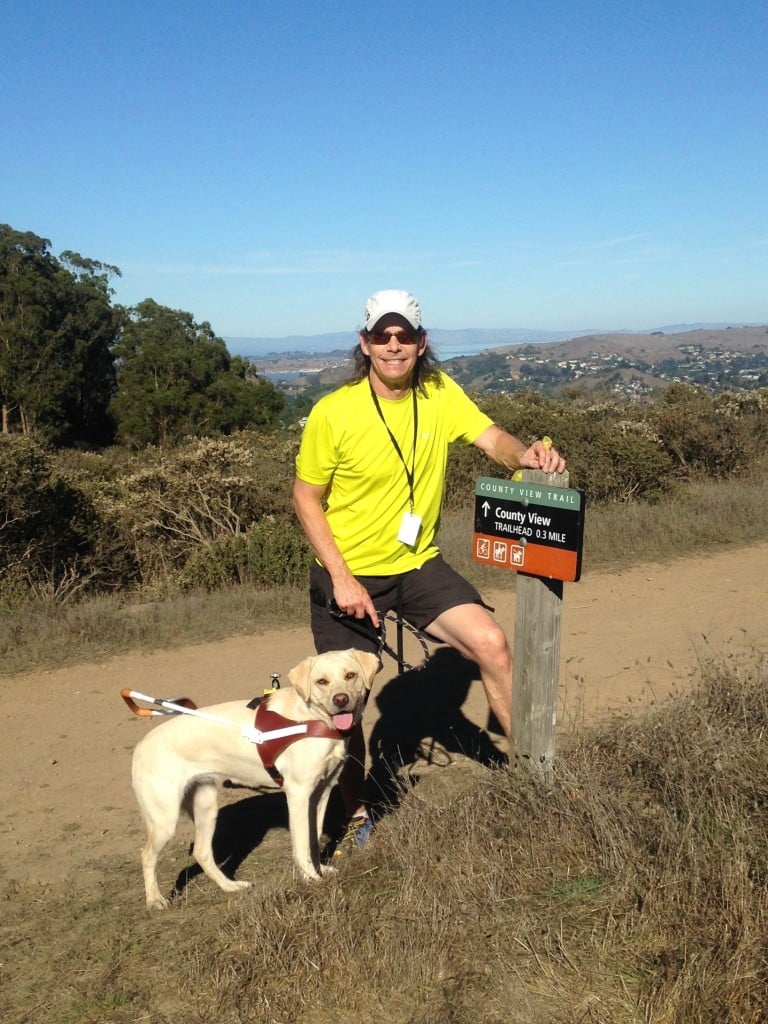
Reaching the summit of Mount Elbert requires 4,000 feet of elevation gain in the thin air atop Colorado’s highest peak.
Trevor Thomas, then 46, and his companion achieved the summit on July 4, Independence Day. The snow-capped Rocky Mountains loomed large in all directions on a beautiful summer day. Thomas couldn’t see them, though, having lost his vision a decade before. His companion was his guide dog Tennille, who led him skillfully on the climb and 486-mile Colorado Trail.
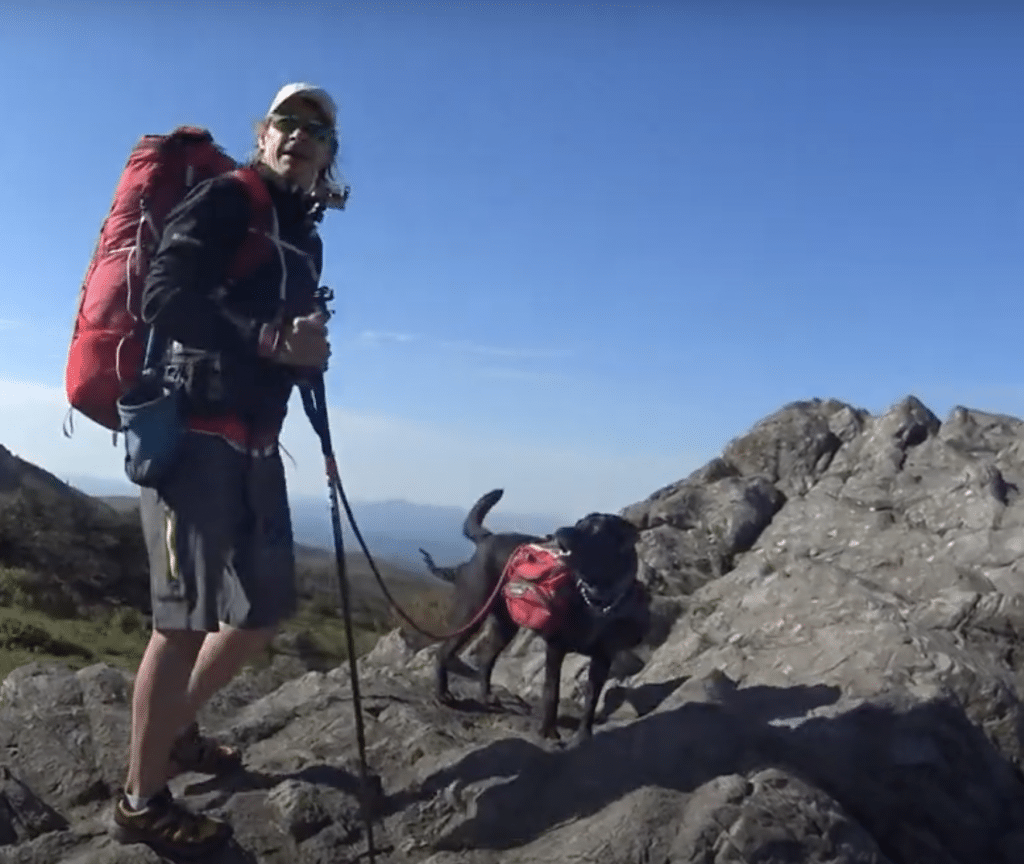
“Tennille, you did it, baby!” Thomas praised his furry friend, who rolled joyfully in the snow. “I guarantee that’s a first for a guide dog. This is what we came here for. It does not get any better.”
Reaching Mount Elbert’s summit and hiking the Colorado Trail were sweet redemption for Thomas, who tasted defeat on the route four years earlier. Then 42 and blind but without a guide dog, Thomas had completed other long hikes like the Appalachian, Pacific Crest and John Muir trails.
Thomas could not have imagined this moment 11 years before when he first noticed his sight was diminishing. In his youth, Thomas lived as an “adrenaline junkie,” enjoying skiing, mountain biking, rock climbing, skydiving and even racing Porsches.
Then an eye exam revealed that he had a rare eye disease called atypical central serous chorioretinopathy. His vision disappeared completely within a year. Depression hit hard.
“I thought I’d been issued a death sentence,” Thomas said. “I knew everything I did in my sighted life would no longer be possible.”
With difficulty, Thomas learned Braille and how to function without vision. An instructor taught him to navigate with a cane. He begged her to take him onto a trail, so they hiked on paths near his North Carolina home. A friend took Thomas to hear a blind mountaineer talk about climbing Mount Everest.
Thomas hatched a plan to trek the Appalachian Trail, a mountainous 2,190-mile odyssey from Georgia to Maine. Thomas had never backpacked before. “Everyone said it would be impossible,” he said, but Thomas prepared for a year. He learned to read engraved trail signs with his hands, to identify the trail by the way it felt beneath his feet, to measure distance by gauging his speed, and to identify terrain around him by sound.
“I do what’s called echo location. I’m pretty much like a human bat,” he explained.
Thomas, then 39, arrived at Georgia’s Springer Mountain. He asked dozens of northbound hikers if he could follow them up the trail. Finally one agreed. For the next six months, Thomas tailed others or hiked solo. Long distance hikers often adopt trail names, and Thomas became known as Zero/Zero, in contrast with a normal vision rating of 20/20.
“I found a community in the hiking world,” he said. “When you’re blind, most people you meet concentrate on your disability first. To the hikers I met, I was just another hiker. The backcountry didn’t care that I was disabled. I got the same weather and the same trail conditions as everyone else. That meant a lot to me.”
Thomas fell 3,000 times before he stopped counting, causing countless bruises, scrapes and cuts. He broke bones in his left foot, fractured his left hip and cracked his skull. The most serious tumble occurred in Maine.
“I really thought I’d become a true backcountry expert, but I got blown off a cornice by wind and broke four ribs,” Thomas said. “It took me five days to get to the next tiny town, with no doctor. I managed to find a large animal vet. He recommended I get off trail.”
But 200 miles later, joy swept over Thomas at the trail’s end atop Mount Katahdin.
“That was the happiest I’d ever been. I felt like I got my life back,” he said.
So began a new life for Thomas. Next he hiked the 2,650-mile Pacific Crest Trail with a group he formed called Team FarSight. Thomas became the first blind person to complete the PCT and to climb 14,505-foot Mount Whitney on the way. He fell dozens of times instead of thousands.
“As you get more experienced, you get better. I learned how to fall, consider myself an expert at falling and came to see injuries as a byproduct of what I love to do,” he said.
When Thomas first attempted the Colorado Trail, he faced new challenges. “It’s one thing to go solo with the safety net of people being around. It’s another thing to go solo and probably be the only person out there,” he said.
Long miles of featureless snow proved a giant problem. “I was concerned about snowpack, but I went anyway,” Thomas said. “But I hadn’t yet figured out how to navigate that. It’s a blind person’s worst nightmare, and psychologically devastating. That became my first non-complete. Those will stick with you. I knew I would have to return.”
But first, Thomas needed a new way to navigate in the backcountry. He decided to get a guide dog and contacted suppliers across the country. “Every one I applied to told me, ‘Dogs can’t do what you want them to do.’”
Guide Dogs for the Blind in San Rafael offered to help. “We try to have open minds and are open to trying new things,” said trainer Larissa Momford.
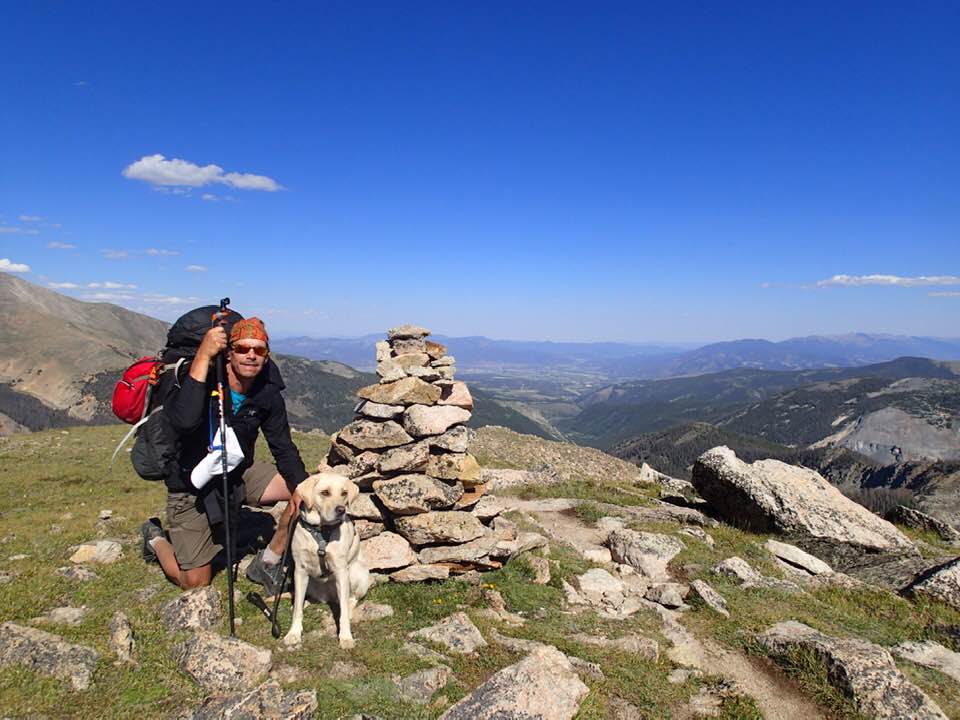
Over a two-week class, Thomas got to know Tennille, a black labrador. In addition to standard training like crossing streets, they took long walks on unpaved trails. “We couldn’t really prepare her for such an extreme lifestyle change, but we made sure she had stamina and resilience to do what Trevor wanted, and she sure did,” Momford said.
Pairing with Tennille changed everything. The next year, Thomas and Tennille hiked the 1,175-mile Mountains to Sea Trail in North Carolina. They followed with the 273-mile Long Trail in Vermont and the 165-mile Tahoe Rim Trail around Lake Tahoe. All three were firsts by a solo blind hiker and guide dog.
Together the two became a team unique in all the world. They advanced to higher and more remote routes. Four years and 6,000 trail miles after the Colorado Trail defeated Thomas, he returned with Tennille to try again.
The trek from Denver to Durango leads over the Rockies and the Continental Divide, mostly above 10,000 feet in elevation and across some of the most rugged terrain on the continent. Most thru-hikers who attempt it fail.
“We had some nasty weather,” Thomas recalled, including heavy monsoon rains, flooding, snow and thunderstorms. “We got to play slalom with lightning bolts,” he said, “but I did find out one very important thing about dogs. As good as I got timing peaks on the PCT, nothing compares to having a dog tell you that you don’t want to go up this peak right now.”
In addition to following trails, finding water and choosing campsites, Tennille warned Thomas against climbing peaks and passes when lightning threatened.
“She showed she was more than just a guide, a friend and a partner. Her skills were just mind boggling.”
Forty-one days after they began, Thomas and Tennille arrived at the trail’s end in Durango. “Each long trail I’ve completed is special, but Colorado stands out,” Thomas said. “It challenged me in ways that I never dreamed possible, and it forced me to step further outside my comfort zone than I’d ever done before.”
Team FarSight evolved into an effective nonprofit group. “I figured I should start giving back,” Thomas said. “If one person is starting to lead a better life, I’ve done my job.” Hundreds of blind and visually-impaired people have experienced hiking, camping, rafting, rock climbing and more through Team FarSight clinics activities.
No longer a puppy, Tennille retired as a long-distance companion. Guide Dogs for the Blind then provided Thomas with Lulu, who became the world’s second guide dog to lead long-distance backcountry hikes.
Now in his 50s with more than 22,000 backpacking miles behind him, Thomas also feels his body aging but refuses to give up ambitious pursuits. “I train harder now before I get out on trail simply so I can enjoy it more,” he said. That physical preparation includes strength training and stretching. He accepts the fact that injuries take longer to heal.
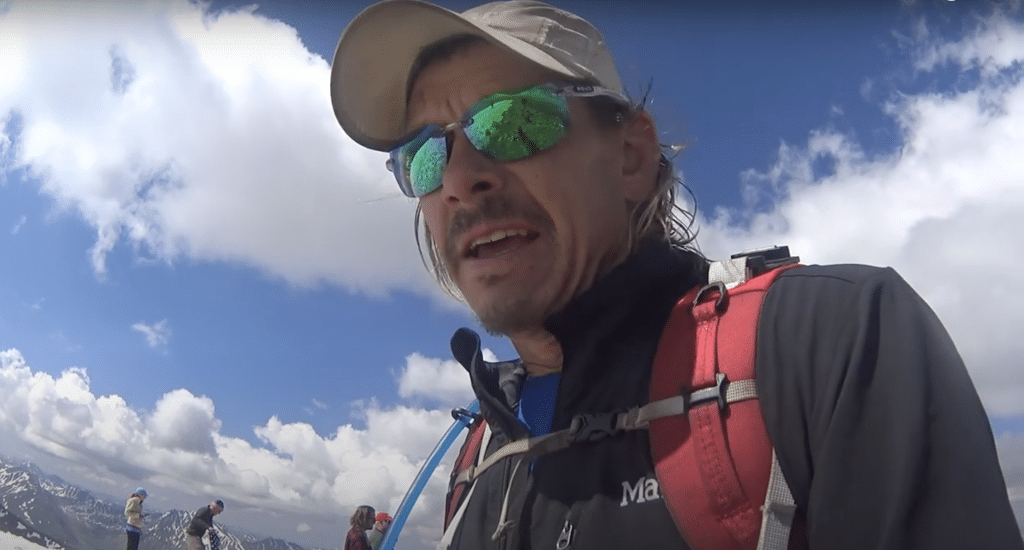
“More aches and pains aren’t going to deter me from what I do. I will hike until the day I die. What you get out of it is so much more than any of the pain that you go through,” he said. “At the end of the day, it’s the price we pay for the sport we love.”
Republish our stories for free, under a Creative Commons license.
Author
Related Articles
Inspiring California Climber Lived His Dream in 2025
And some of the other top outdoor news from the past year
Can an Opponent of Public Lands Safeguard Them for Us?
If Bureau of Land Management Director Nominee Steve Pearce gets the job, it would be like a fox guarding the hen house
“Hike Your Hike”
A Pacific Crest Trail Journey, Part 6