
The Boxes We Build, Part III: Beyond Solitary
From policy to personal cost, what solitary confinement reveals about who we are, what we value, and the change still within our reach.
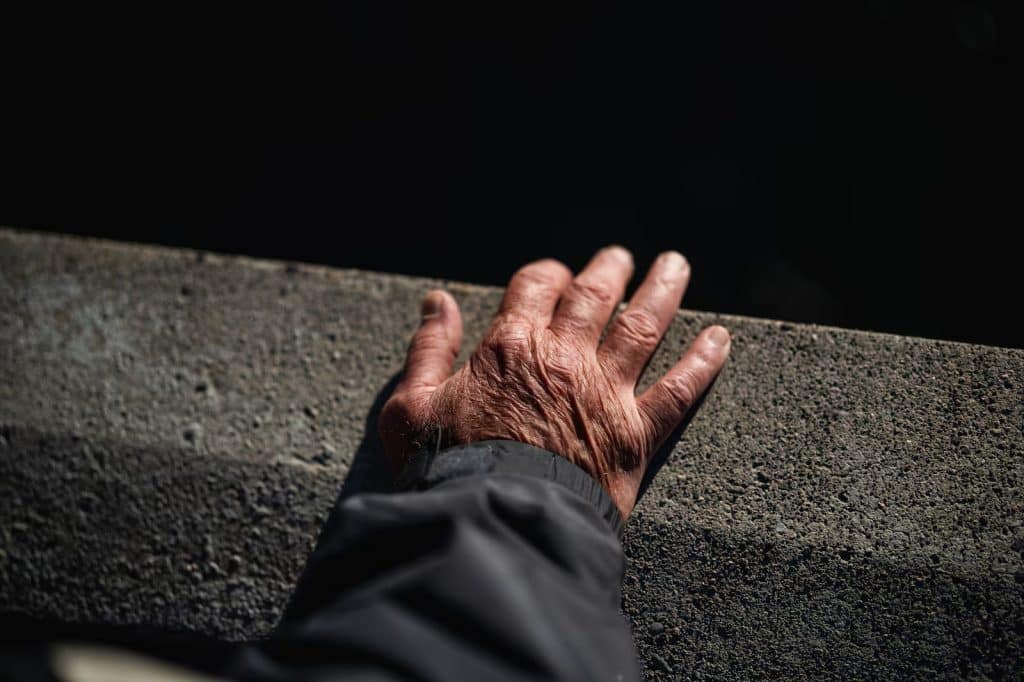
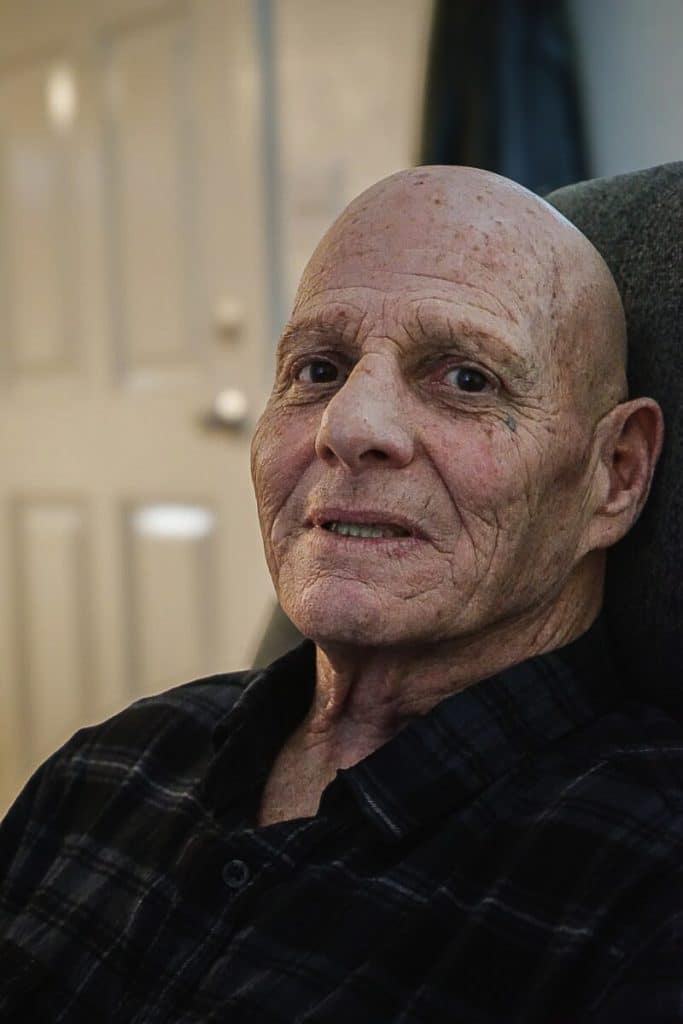
After 22 years in solitary confinement, Frank De Palma now lives in Reno. Photo Hannah Truby / Sierra Nevada Ally
In Part 2 of this series, we explored the use of solitary confinement in Nevada and the United States, tracing its reach and comparing its toll to that of other Western nations.
The continued use of solitary confinement doesn’t just fail those inside—it hinders their return to society and forces all of us to face an uncomfortable question: if solitary confinement is meant to erase people, what does its persistence—and the broader failings of the American prison system—say about us as a society?
Frank’s story exposes a deeply flawed system, but step back and the patterns of incarceration across the country tell us something more: about our values, our priorities, and the ways we choose to treat the most vulnerable among us.
Disappearing Acts
When Nevada’s SB307 passed, Frank De Palma reflected in an op-ed for The Nevada Independent that the bill “didn’t get much attention, probably because it pertains to a relatively invisible and largely disdained segment of society—the imprisoned.”
One reason our prison systems are so resistant to change is that their worst abuses occur behind closed doors, shielded from public view (which is largely why, even with SB307’s passage, advocates are uneasy about exactly how it is being enforced). Few correctional systems have the independent oversight or transparency needed to uphold constitutional protections, such as the Eighth Amendment’s ban on cruel and unusual punishment.
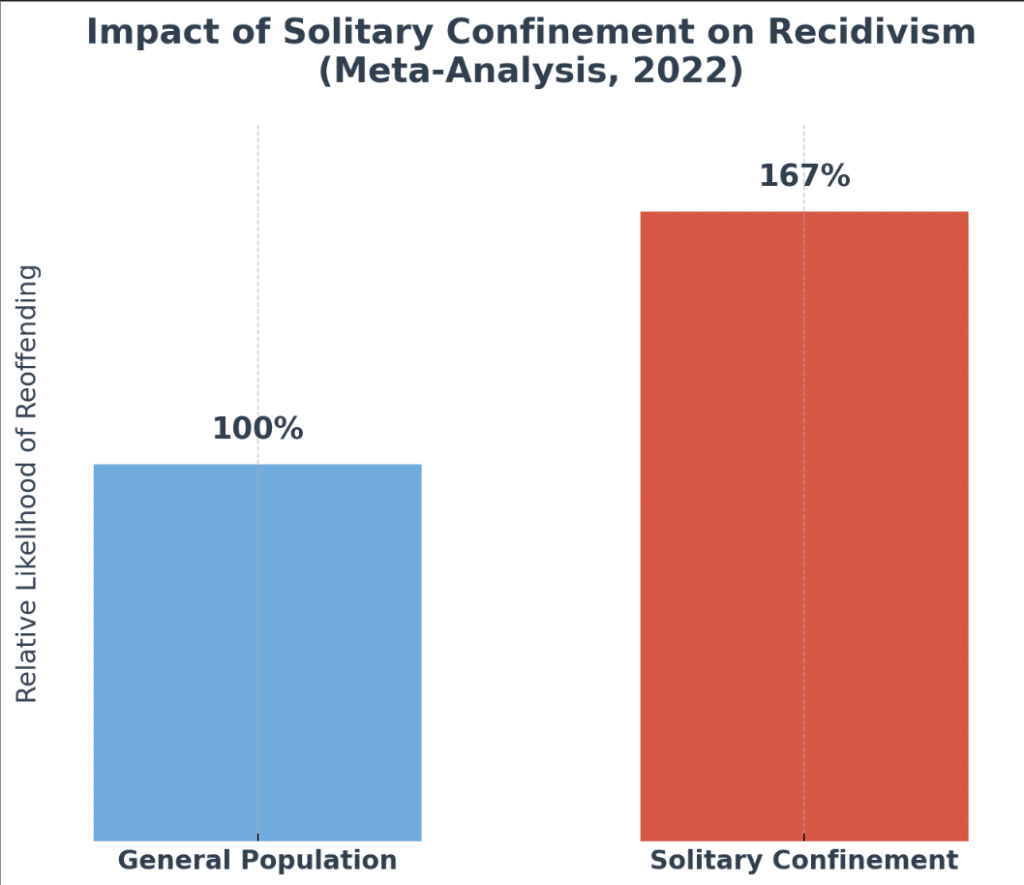
Solitary confinement, studies show, torments the body and warps the mind, thus stripping the basic social and coping skills necessary for life outside of prison. This, compounded by the near total lack of reentry support, means those who have experienced solitary confinement are 67% more likely to reoffend than those who have not.
Frank would be the first to admit he was in rough shape in those early days. He wouldn’t have trusted someone like himself.
“The truth about our criminal justice system is that it’s a great big failure. It’s a burden to society,” he said. “I was that kid next door. I went in scared to death, but my desire to stay alive became stronger and I became a bad person. I did. I wouldn’t have been a good neighbor. I became somebody who didn’t belong out of prison.”
Frank was released from the prison’s general population into the general public in December 2018. He was 62, and the world he had left behind at 18 was long gone. His parents had died, technology transformed daily life and, though finally free, he was met with a host of new fears: poverty, homelessness and deteriorating health. Halfway houses turned him away. Employers wouldn’t hire him.
“I paid my debt to society, a halfway house is supposed to accept people like me,” he said. “But the resources for people like me are almost non-existent. So people go back to what they know best.”
If one were to design a system to perpetuate generational cycles of violence and incarceration, especially in communities already overburdened by criminalization, the American prison system would be it. The Bureau of Justice Statistics found that 66% of people released from prison are rearrested within three years. Over a ten-year period, 82% are arrested again.
In the second part of this series, Dr. Breea Willingham, a professor of sociology and criminology and editor of Punishment and Society, called it “structural negligence, not public safety. It isolates people at their most vulnerable and then expects them to return to society whole.”
Professor of Critical Prison Studies Lisa Guenther agreed, and said the entire system is built around control.
“Some institutions are designed for care, healing—like nursing homes or psychiatric facilities,” she said. “Others are structured around control, and the intertwining of care and coercion is hard to escape in a society built on locking people in and out.”
American Values on Trial
Our propensity to disappear individuals, of course, is not confined to prisons. It is necessary to include how the same tools of erasure appear in immigration detention centers today, where watchdog investigations have revealed ICE facilities isolate detainees, often without due process or oversight, and without access to legal resources.
“Solitary is just one piece of a much bigger machine built to obliterate people,” said Dr. Willingham. “From encampment sweeps to ICE immigration raids—that barbaric ‘Alligator Alcatraz’ comes to mind—the aim is always the same: get them out of sight, out of mind, and off the system’s conscience.”
These ongoing human rights violations are not outliers, but symptoms of a deeper ethos: American systems repeatedly respond to social harm not with repair, but with erasure.
There exists a kind of emotional and cognitive wool surrounding those of us who live in safety and freedom—but the truth is that comfort comes at the expense of others: spun from their subjugation, cemented by their erasure.
What We Call Efficiency
The United States doesn’t have one single criminal justice system. It has thousands, each with its own rules, facilities, and cages. Together, they confine more than 2 million people: in state prisons, federal penitentiaries, local jails, juvenile centers, immigration detention facilities, Indian country jails, military prisons, psychiatric hospitals, and even in U.S. territories. Maintaining this sprawling network costs at least $182 billion each year.
Of those 2 million people, more than 95 percent will eventually return to the community—around 600,000 each year. Yet more than two-thirds will be rearrested within three years, and half will be reincarcerated. Given these numbers, ensuring incarcerated people leave prison with the tools to survive and thrive should be a public health priority—but the data speak to the fact that these systems fail miserably.
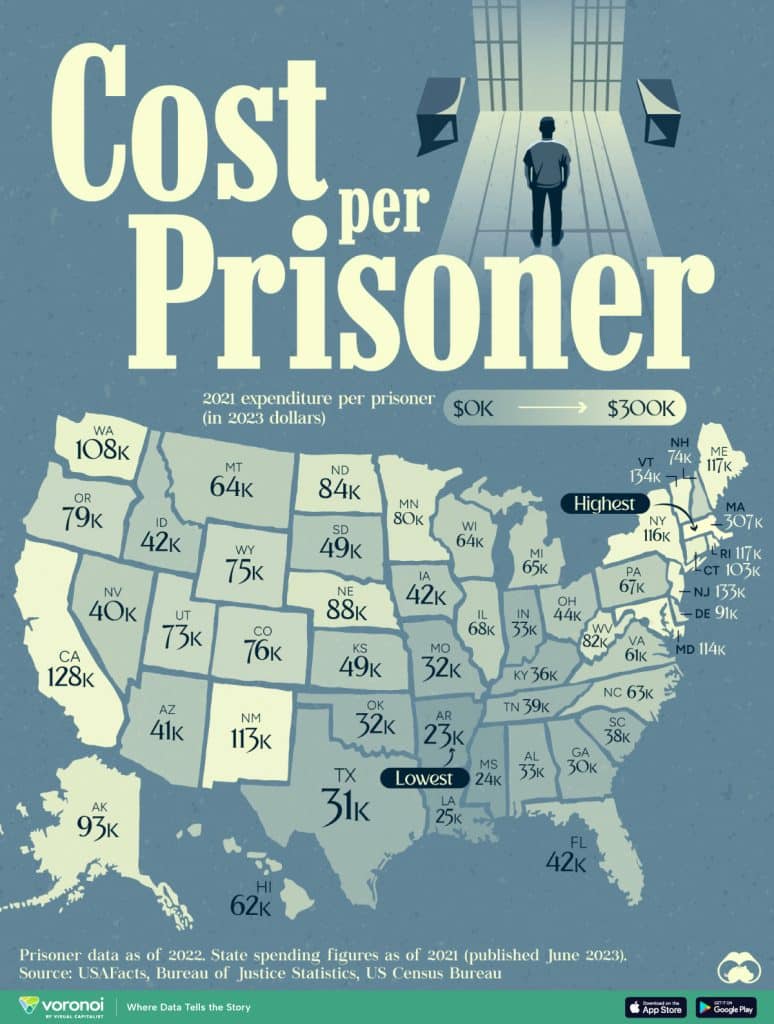
Solitary confinement compounds these failures. Housing a person in isolation for a year costs taxpayers roughly $75,000—three times the cost of general population incarceration and nearly five times the federal poverty level for a single individual. While other nations invest in rehabilitation, the U.S. prioritizes “efficiency” over the well-being of those behind bars.
“Efficiency, in this case, means: how many bodies can we shove under one roof as cheaply as possible. That’s American corrections,” said Rick Raemisch, the former head of Colorado’s Department of Corrections.
Raemisch is nationally recognized for leading groundbreaking reforms to solitary confinement. (He famously spent 20 hours in solitary himself—an experience he later chronicled in The New York Times.) During his tenure in Colorado corrections, Raemisch’s system of roughly 20,000 adult inmates phased out solitary confinement almost entirely “in less than a year and a half,” largely by implementing reforms rooted in normalcy, reintegration, and mental health—models inspired by places like Sweden, Norway, and Germany.
“When people ask me about European models versus American models, I say we invest in efficiency, and Europe invests in corrections,” he said.
“But what’s the cost for someone to go out, commit, and recommit a crime—the victims, the courts, the prison expenses? You lump all that together, it’s not very efficient at all.”
Under Raemisch’s leadership, the use of solitary confinement was limited to no more than 15 consecutive days. But Raemisch emphasized that lasting change—both inside the facilities and after release—would take more than policy tweaks.
His department replaced segregation with various programming; they introduced structured social time, educational and therapeutic programs, and significantly increased both general and mental health staff numbers.
“Staffing in Europe is close to one-on-one, if not one-on-one. It wasn’t unusual to see correctional officers helping people learn to cook, assisting with daily tasks, playing board games—just building trust,” Raemisch said.
When staff are trained not just as guards but as mentors, he added, violence inside prisons drops dramatically. He called the results “nothing short of a miracle”—for both staff and incarcerated people.
Reform also has economic benefits. While state legislation sets the rules, Raemisch emphasized that funding is critical to support these reforms. A recent analysis of California’s Mandela Act on Solitary Confinement found that California could save upwards of $61.1 million per year by implementing similar reforms.
The Humanity We Keep
Today, Frank De Palma’s life is marked by both silence and freedom, this time on his terms.
In Frank’s apartment, the light has shifted, casting long shadows across the carpet. After two hours of conversation, he remains as content with my presence as when I first walked in. Fatty, his cat, has tucked herself beneath the coffee table, hidden behind a sarong draped like a curtain.
“She’s got it made,” Frank laughed. “Sometimes when she really wants to be alone, she’ll crawl inside the couch.” He pauses, keeping his eyes on Fatty. “You know, I learned something in that cell they never meant for me to learn—maybe they don’t even know. That cell stole everything that made me human, by depriving me of it. But in all that aloneness, I came to understand what it means to be human.”
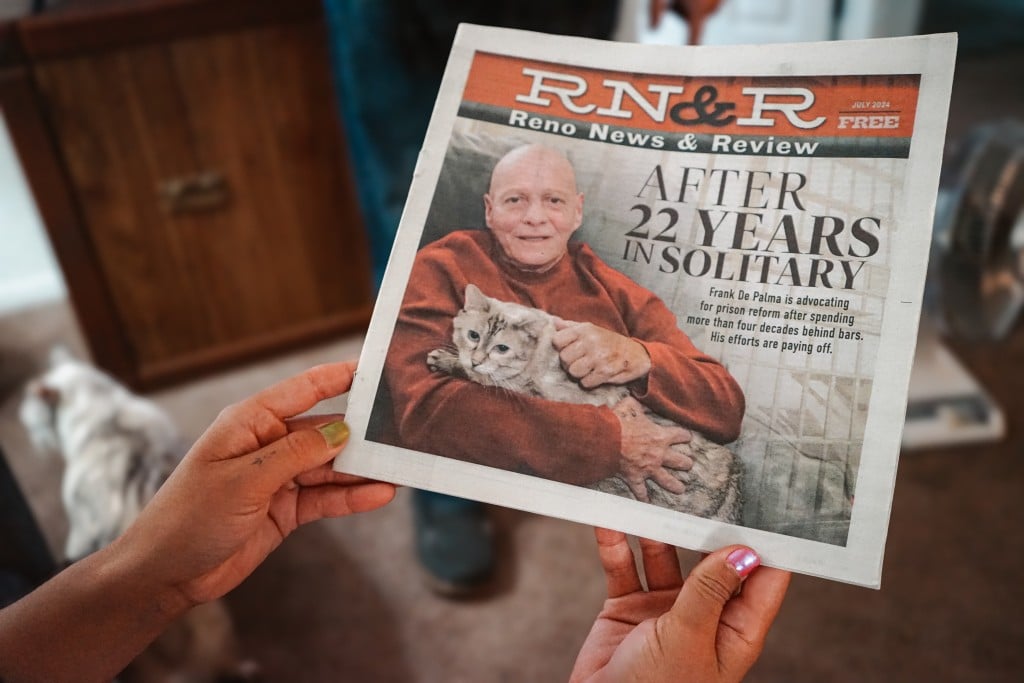
There are parts of himself Frank knows he’ll never get back—he says he sometimes feels like ‘Swiss cheese’—but piece by piece, he’s reclaiming what was taken and building something new. His is not just a story of survival, though statistics might predict otherwise. Whether by grit, grace—or what Frank calls ‘a few angels’—he endured, adapted, and begin again.
Since his release, he’s enrolled in intensive therapy, adopted Fatty, and built a close circle of friends. His agoraphobia still flares from time to time, but he’s learning to reason his way through it, practicing small acts of agency each day.
“I really enjoy cooking,” he said. “And I still get a kick out of going outside—just because I can. I don’t have to wait for someone to unlock the door. It’s those little, simple things.”
Frank has also, of course, become an advocate for prison reform in the years since his release.
In 2021, Frank testified before the Nevada Senate Judiciary Committee about the torture of solitary confinement, which helped spur reforms like SB307. In 2021, he published his life story: Never to Surrender! 22 Years in Solitary: The Battle for My Soul in a U.S. Prison.
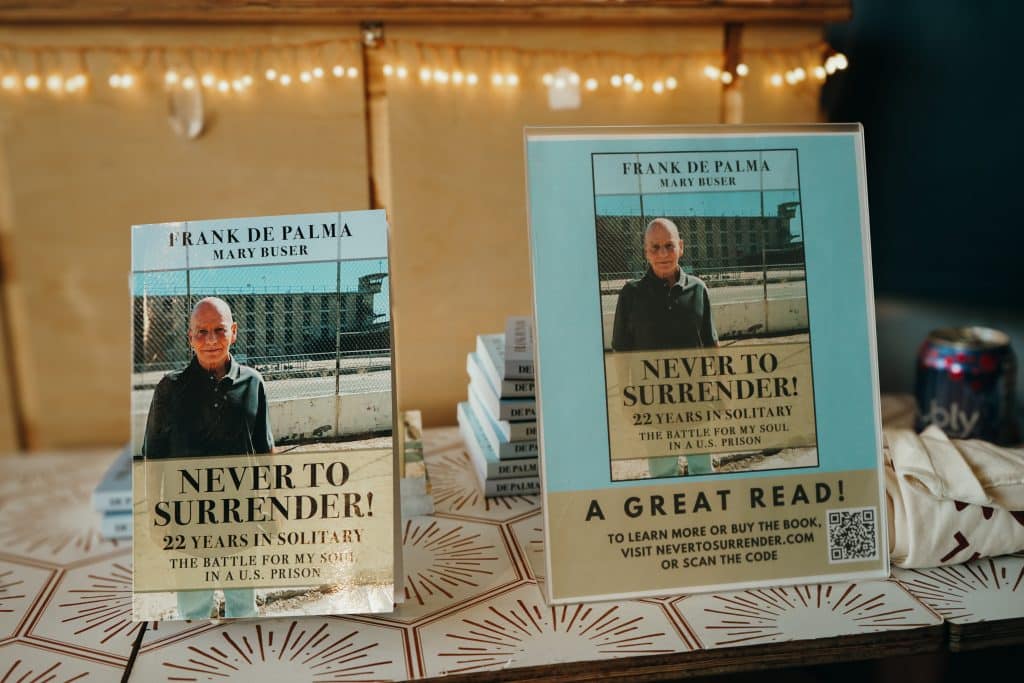
Frank said he sometimes gets the sense that people pity him when they hear his story.
“I don’t want that from anybody. Man, take your pity and shove it. I don’t deserve that. If anything, just respect me. Don’t judge me,” he said. “But people who’ve been in prison are judged. We’re already a stain on society. If you’ve got ten people applying for a job and nine of them are ex-felons, you’re going to pick the one who’s not. That’s understandable. But is it fair? When they fail, whose failure is that—theirs, or ours?”
His question lingers.
Because Frank’s story isn’t just about who he is or what he’s endured—it’s about who we are. About what we tolerate, how we justify, and who we choose to look away from.
Solitary confinement doesn’t just strip people of their humanity; it reflects something of our own. A silence we impose–and pay for. A violence we normalize and hide from view. A fear—of reckoning, of change, of each other—that we institutionalize.
And that is what solitary says about us: not just that we have allowed such suffering to persist, but that we still could choose otherwise–and still haven’t.
If there is meaning to be found in suffering, perhaps it lies in the telling of it,” Frank wrote in his book.
“And in listening—in remembering together what it means to be human—perhaps therein lies the road ahead.”
This work is made possible by Press Forward, a national coalition investing more than $500 million to strengthen local newsrooms and close longstanding gaps in journalism coverage. Donate to join the movement and support coverage on civics, climate and community in the Sierra Nevada region.
Republish our stories for free, under a Creative Commons license.
Author

Related Articles
Tracking Food and Gas Prices in the Trump Era (Updated for December)
President Donald Trump campaigned on the promise of lowering grocery prices for everyday Americans. We’re tracking how that’s going.
The Realities of Our Rapidly Changing Immigration Landscape
While most immigrants come to the United States legally, one Reno-based immigration attorney says doing things “the right way,” is complicated, expensive and full of roadblocks.

How does a special session in Nevada work?
The recent special session of the Nevada Legislature is behind us. How are they called?