
The Federal Purge That’s Gutting Our Public Lands
Billionaire Elon Musk’s Department of Government Efficiency has aggressively targeted the federal civil service—recently, those responsible for protecting and maintaining the nation’s prized public lands.

As part of the Trump administration’s broader push to downsize the federal workforce, thousands of employees from agencies responsible for protecting the nation’s public lands have been laid off.
Under the leadership of Elon Musk’s Department of Government Efficiency (DOGE), more than 200,000 federal workers lost their jobs this month alone—including 3,400 from the U.S. Forest Service.
The cuts represent a 10% reduction in the U.S. Forest Service workforce and, for an agency tasked with overseeing 193 million acres of public land and providing clean drinking water to 180 million Americans, signal an ominous and uncertain future for the health of forests, public lands, and the communities that rely on them.
The People Behind the Jobs
“The old idea that public servants should serve all Americans, and not just a small elite, has been part of American culture for more than a century,” wrote The Atlantic’s Anne Applebaum.
DOGE’s approach of ending the ‘tyranny of bureaucracy’ by eliminating public servants—i.e., federal workers—is not only destructive, but a misguided view of what federal employees actually do, and the crucial role they play.
Editor’s Note: Elon Musk has not been elected nor appointed and confirmed to an official role by the U.S. Senate, a requirement of the U.S. Constitution to maintain separation of powers. DOGE therefore is conducting unconstitutional acts, and is currently being sued by multiple state attorneys general.
The workers being purged are not fraudster bureaucrats—they are ecologists, recreation managers, wildfire mitigation experts, and field technicians. They are the ones maintaining trails, managing forests, and ensuring that our land remains protected in the face of increasing environmental threats. Their work is not just technical; it’s the foundation of our nation’s natural infrastructure.
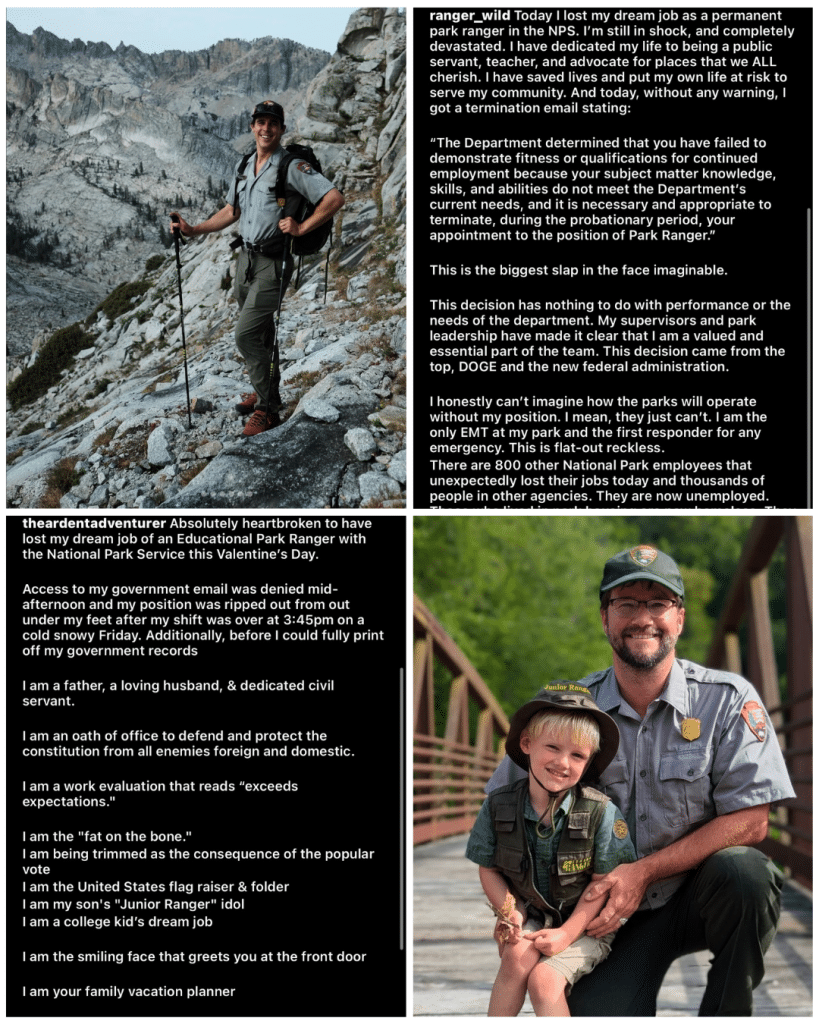
The majority of workers laid off were those in a “probationary period”—recent hires and employees who were promoted or moved to a new position. In a recent press release, U.S. Senator Maria Cantwell, a democrat from Washington state, says that these are people who “lack full civil service protections and appeal rights because they do not have these protections, not for performance reasons.”
This all seems to be part of the Trump administration’s plan, following the playbook of Project 2025. The 19th News recently reported about Russell Vought, a key architect behind Project 2025 and the newly-confirmed head of the Office of Management and Budget (OMB), which puts together the yearly presidential budget proposal.
“The chapter that Vought wrote for Project 2025 detailed how the budget agency could be used to withhold money appropriated by Congress and eliminate dissent within agencies by purging them of employees,” The 19th News reported.

The Fallout of the Purge
With reduced staffing in key public land agencies, including a 20% reduction at Nevada’s only national park, there is now a diminished capacity to effectively manage and protect the nation’s prized public lands.
For the U.S. Forest Service, that could spell trouble during times of higher wildfire risk. Recent wildfire seasons have exposed the critical understaffing and resource shortages that already plague the agency, and now, with fewer hands on deck, the ability to mitigate fires before they escalate into catastrophic events is in jeopardy.
While the layoffs excluded firefighters, Amanda Monthei said the answer to whether or not the cuts will affect fire operations is a resounding yes. Monthei is a former wildland firefighter who now hosts the Life with Fire podcast.
“The absence of these workers threatens the very fabric of our environmental and economic systems. It’s not just about forest management—it’s about the future of wildfire prevention, the health of ecosystems, and the safety of the communities that live within and around these lands. When wildfires rage unchecked, it’s not just an environmental disaster—it’s a public health crisis and an economic one,” she said during a recent episode.
The economic ramifications extend far beyond the Forest Service itself. Outdoor recreation is a $1.2 trillion industry, one that relies heavily on well-maintained public lands. From trail systems to forest access, these areas support millions of jobs and serve as a vital economic engine for rural communities. Without proper care and stewardship, this vital resource could wither, taking with it jobs, tourism, and the outdoor culture that is integral to many communities across the country, and potentially replace them with oil rigs and critical mineral mining operations.
In Nevada, where the federal workforce is particularly significant, the cuts are already being felt. Northern Nevada has the highest percentage of federal workers in the state, with communities like Fallon heavily reliant on federal jobs. According to the U.S. Bureau of Labor Statistics, there were around 184,000 people working in government in October 2024. Other reports have said about 22,600 of those were working for the federal government, which would comprise about 1.5% of the state’s labor force. Of these, many work to manage Nevada’s public lands, which make up more than 80% of the state’s land mass. These civil servants work to assist Nevada’s farmers and ranchers, who work the land on approximately 6.1 million acres in Nevada.
As the purges continue, the number of federal workers will shrink, leaving an economic and environmental void in their wake, as well as more competition for fewer jobs in the private sector.
The loss of federal workers in the U.S. Forest Service and beyond has real ramifications. Outside of the day-to-day management of lands, these workers are real humans with real expertise. Once these positions are lost, it will be much harder—if not impossible—to restore them. The loss of expertise, institutional knowledge, and manpower will take years to rebuild, if it can be rebuilt at all. After all, who can trust that a “stable” government job will be stable anymore?
The stewardship of our public lands has historically enjoyed bipartisan support, but the actions of DOGE threaten to undermine that legacy. The cuts jeopardize not only the lands themselves but also the communities that rely on them for drinking water, recreation, and economic stability.
While some lawmakers, such as Sen. Cantwell, have raised alarms, the question remains: can they intervene before the damage becomes irreversible? The U.S. Department of Agriculture, which oversees the Forest Service, remains steadfast in its support of these cuts, with Secretary Brooke Rollins defending the effort. A USDA spokesperson responded to our requests for an interview with the following statement.
“Secretary Rollins fully supports the President’s directive to improve government, eliminate inefficiencies, and strengthen USDA’s many services to the American people. We have a solemn responsibility to be good stewards of the American people’s hard-earned taxpayer dollars and to ensure that every dollar spent goes to serve the people, not the bureaucracy. As part of this effort, USDA has made the difficult decision to release about 2,000 probationary, non-firefighting employees from the Forest Service. To be clear, none of these individuals were operational firefighters. Released employees were probationary in status, many of whom were compensated by temporary IRA funding. It’s unfortunate that the Biden administration hired thousands of people with no plan in place to pay them long term. Secretary Rollins is committed to preserving essential safety positions and will ensure that critical services remain uninterrupted.”
What Can Be Done?
If you’re concerned about these issues, contact your Congressional representatives. You can fill out petitions that have been made by organizations like The Outdoor Alliance and National Parks Conservation Association.
Additionally, support for public land conservation associations can go a long way in helping to fund critical programs and build solidarity among public land advocates. Some of these organizations include:
- National Parks Conservation Association @npcapics
- National Forest Foundation @nationalforests
- Trust for Public Lands @trustforpublicland
- Appalachian Mountain Club @appalachianmountainclub
- Pacific Crest Trail Association @pctassociation
- Western National Parks Association @wnpa_1938
- National Parks Foundation @nationalparkfoundation
- Washington National Park Fund @wanatlparkfund
Editor’s Note: If you’re a federal worker that’s been affected by these layoffs, we want to hear from you. Email editor@sierranevadaally.org to share your experience.
This work is made possible by Press Forward, a national coalition investing more than $500 million to strengthen local newsrooms and close longstanding gaps in journalism coverage. Donate to join the movement and support coverage on civics, climate and community in the Sierra Nevada region.
Republish our stories for free, under a Creative Commons license.
Author

Related Articles

Ally Audio: Where’s the Mountain Snow We All Love?
Check out the latest edition of Sierra Nevada Ally’s podcast
When Winter Comes as Rain in the Sierra Nevada
A warm, wet start to the season is reshaping snowpack — and what it means for local businesses in Truckee and beyond.
Can an Opponent of Public Lands Safeguard Them for Us?
If Bureau of Land Management Director Nominee Steve Pearce gets the job, it would be like a fox guarding the hen house