
A Prospect from Singing Mountain
Damned ancient Mayans. In anticipation of the end of the world on December 21, I put off my Christmas shopping, blew off my writing deadlines, told a few folks what I actually think of them, and ran up a huge whiskey bill on my credit card. But as we enter the new year it has become obvious that prophecies about the apocalypse belong with weather reports, political predictions, and football bets. You know you’re part of a cosmic crapshoot when even the end of the world turns out to be a disappointment. Now we’ll just have to hang tough until the Earth’s impending collision with the planet Nibiru. At least I’ll have ample sour mash and rye while I wait around for a more dependable cataclysm.
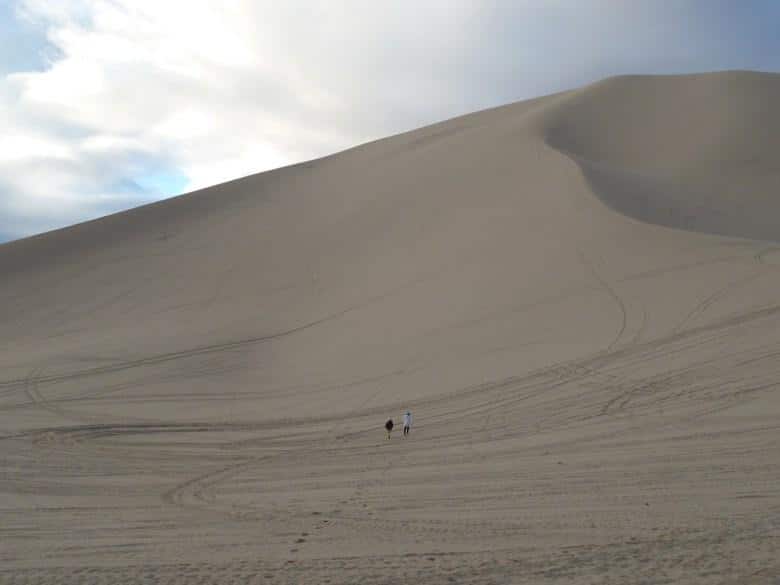
To appreciate Sand Mountain requires vast leaps of imagination. Fifteen thousand years ago the Sierra Nevada range 100 miles east of here was heavily glaciated, but a subsequent warming trend began to melt the glaciers, dumping enough water down the eastern Sierra to fill immense expanses of the Great Basin with massive inland lakes. Ancient Lake Lahontan, which extended across much of present-day northern Nevada, once covered 8,500 square miles of now desiccated high desert and was up to 800 feet deep. Toward the end of the Pleistocene Epoch the giant lake began to dry up, and by 4,000 years ago it had contracted so far as to expose the spot where Sand Mountain now rises.
This is the story of the birth of Sand Mountain, which is still being born. As the massive, retreating glaciers scoured the Sierra Nevada, they ground off flakes and pebbles of granite, which were further degraded as they tumbled down rivers and were borne out into the Great Basin. At the delta of the Walker River near Shurz, Nevada (pop. 896)—where the Ghost Dance prophet Wovoka lies buried in the Paiute graveyard—this granitic sand accumulates in a place that is made special by wind. The prevailing Southwesterlies swoop down and gather up this mountain-blasted and river-trundled sand, lifting it high into the air and carrying it across the open high desert more than thirty miles, where the flanks of the Stillwater Mountains at last slow the winds, forcing them to drop their payload of Sierra sand in this magical spot. Over time this weird, lovely pile of sand has grown to 600 feet, making Sand Mountain one of the tallest dunes in North America.
Sand Mountain is one of only thirty-five dunes on the planet that knows how to sing. A “singing dune” consists of what is called singing, whistling, or even barking sand—sand that can make a roaring or booming sound. Although scientists aren’t entirely sure how the sound is created, it has to do with the rate of collision in the shear band where avalanching sand on a steep face contacts the static sand below. Even dunes well situated to sing remain silent unless consisting of perfectly clean sand with silica-based grains of a specific and nearly uniform size and shape. When Sand Mountain sings, it produces a unique note of between 60 and 105 hertz. Northern Paiute and Western Shoshone people have long honored this distinctive song, which they attribute to Kwansee, their ancient tribal benefactor, who lies buried beneath the dune and who sings for his lost love.
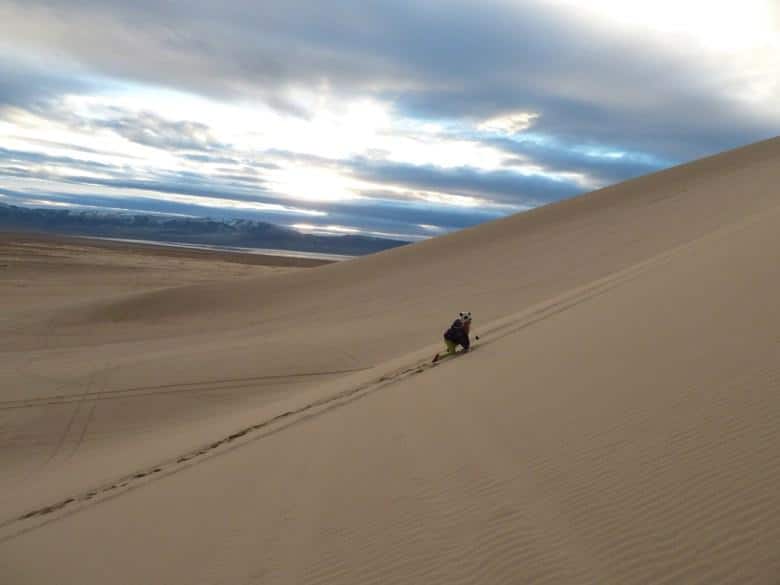
When Eryn and the girls and I arrived at Sand Mountain, the sun was setting into the horizon clouds and dropping for home. Although it was cold and windy the snow held off, so we decided to take the girls and try for the summit ridge of the dune before dark, clambering first up the flank of the mountain and then along one of its winding knife ridges straight up into the sky.
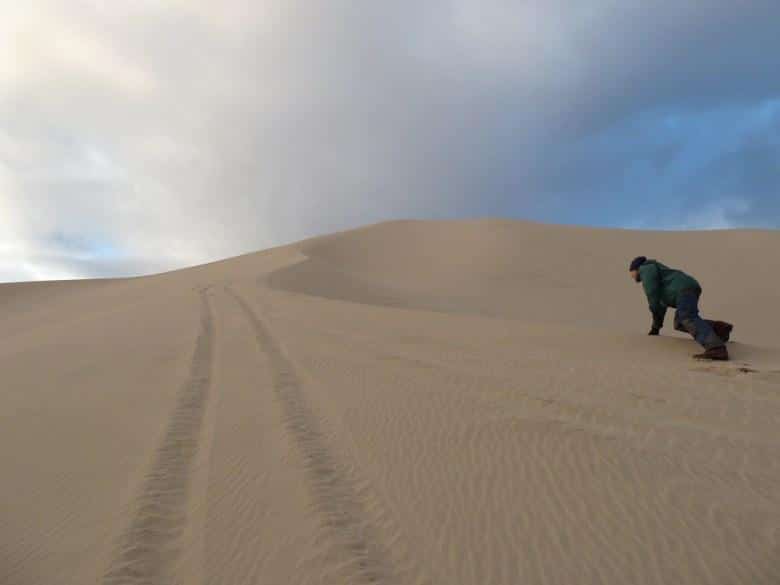
Each step pushed a small avalanche of sand behind us, making the climb challenging, so eventually we adopted the technique the girls had instinctively known to use from the start, scrambling upwards on all fours. At last we reached the summit, which turned out to be a single ridge so incredibly narrow that we all straddled it as if riding horseback, in order to keep from sliding down the even more precipitous incline on the far side. From this precarious position we had a sweeping view along the dragon-backed ridge of the giant dune, down to the expansive playa below, and then out to the basin and range country rippling to the distant horizon.

From our perch we discerned no life apart from our own, but there is one secret life that is lived here, and here alone. The Sand Mountain blue butterfly (Euphilotes pallescens arenamontana) is a lovely little sister in the family Lycaenidae, the gossamer-winged butterflies. It lives nowhere on earth save for this strikingly sinuous massive mound of sand. The little blue’s existence is restricted to this place because its survival depends entirely on Kearney buckwheat (Eriogonum nummulare), a local plant that is the sole food source for its larvae. The Sand Mountain blue spends its entire life within 200 feet of this host plant, and that life consists of no more than one single, beautiful week. We too often forget how much life-changing beauty a week can produce. The little blue butterfly is here because of the buckwheat, which is here because of the dune, which is here because a special wind delivered the harvest of a long-vanished glacier that patiently turned a mountain of stone into one of sand.
Prospect, a word that only became associated with mining in the 1840s, has been used since the early fifteenth century to describe “the act of looking into the distance.” By the early sixteenth century the word also connoted an “extensive view of the landscape,” and since the early seventeenth century its meaning has expanded to reference a psychological outlook, a “mental view or survey.” At its Latin root, prospect implies a vantage from which to look ahead of oneself into both space and time (“pro” means “forward”). To experience a prospect is to have a view of the land, of oneself, and of what is yet to come. And what was the prospect from the windy, knife-ridge summit of Sand Mountain? Night descending on endless salt flats. The Great Basin rolling out to forever. My smiling daughters sitting on top of the world. The old year dying before me, already mid-burial in these shifting sands. I can’t see the future from here, but there is no apocalypse in sight.
The desert darkness began its long fall, and the time had come to descend Sand Mountain. We agreed with the girls that we should all head downhill in the most exciting and dramatic way possible: by rolling. We lay down laterally along the ridge, pulled our hats down firmly, tucked our arms in tightly against our bodies, and then held our breath and let gravity take over. The pitch was surprisingly steep, and we gained speed so quickly that we were soon blasted out of rolling position and into a wild tumble down the face of the dune. The sand cascaded away before us as the world spun and spun, and we fell into the new year, the mountain falling gently with us. When we reached bottom, little Caroline, her face and hair completely covered in sand, pumped her fists above her head and shouted “That was magnifulous!”
As the old year becomes the new, I am still waiting for my imagination to return from Sand Mountain. I contemplate a 600-foot-tall dune of white sand that was brought to its place one grain at a time over the windswept course of four millennia. It is a graceful heap of the powdered bones of the Sierra Nevada, pulverized by glaciers, tumbled in rivers, lifted by wind, carried aloft to a new home. Like its rare butterfly, this mountain can exist in only one place, where the conditions necessary for its existence conspire to make its unreal beauty not only possible but necessary and inevitable. And yet the mountain changes shape every year, and every hour. It flows, like the currents of water and wind that formed it. Like an advancing or retreating glacier. Like time, which moves mountains.
My dream is to become as endemic to the high desert as Sand Mountain and its petite blue, but the shifting sands that turn these years remind me that we are being constantly resculpted by movement and change. Tempus fugit, ergo carpe diem. Because even mountains flow, I am far too old not to roll down them with my children.
An earlier version of this essay appeared as “Singing Mountain” in Mike’s book Rants from the Hill: On Packrats, Bobcats, Wildfires, Curmudgeons, a Drunken Mary Kay Lady, and Other Encounters with the Wild in the High Desert (Roost Books, 2017).
Republish our stories for free, under a Creative Commons license.
Author

Related Articles

Wild Christmas Pinyon
While you might imagine that artificial Christmas trees may be traced back only as far as the glory days of plastic in the 1950s, people actually began making fake holiday trees in the mid-nineteenth century.
The Washoe Zephyr
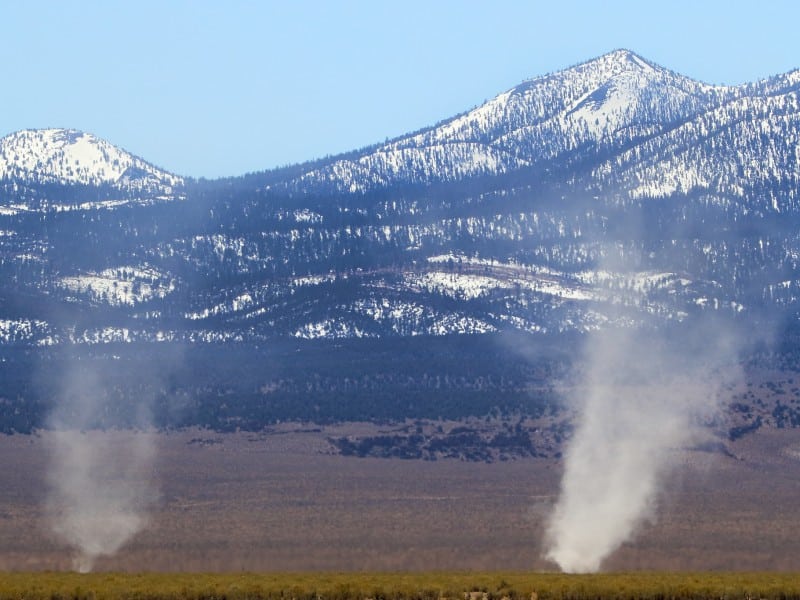
A signature wind that Mark Twain called a “soaring dust-drift about the size of the United States set up edgewise”.
Scaling Lone Tree
Stalking a one-tree forest in the Great Basin Desert.