
“A Conflicting Feeling:” A Local Venezuelan’s Perspective on the U.S. Capture of Nicolás Maduro
What does the seizing of the Venezuelan leader mean to the millions who have fled the country? We ask one.
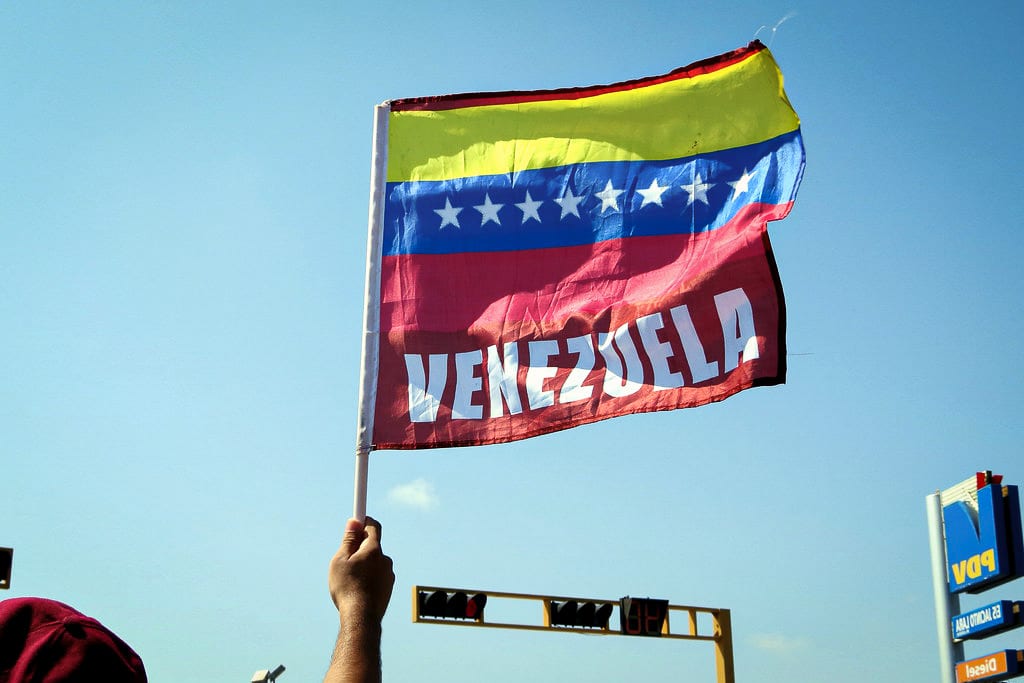
As of December 2025, more than 7.9 million Venezuelans, or 23 percent of the population, have left the country since 2014, according to U.N. International Organization for Migration. So when the United States last month captured Venezuelan president Nicolás Maduro and charged him with, among other things, narco-terrorism, it left many of us with questions. What does that mean for the people of Venezuela? What about those who already left?
Luckily, I have a friend and colleague, Leo Davis, who could add some context and perspective on the situation. He grew up in Venezuela and now lives in Reno.
“It’s a conflicting feeling of satisfaction that there is justice, but at the same time a lot of unknowns,” Davis said about Maduro’s capture.
With decades of a declining economy and now an ever evolving situation of American intervention today, Davis doesn’t jump to conclusions about what happens next for his home country.
“For many years, between protests, voting, elections, all these things, it hasn’t gone anywhere,” he said. “So every time that we hear the news and the ‘Venezuela’ word comes up, we are a little bit numb to the possibility of change.”
For Davis, who grew up in Caracas and left as a teenager, Maduro’s capture is not a neat turning point. It is one more moment in a long story of hope, repression, and forced migration of nearly 8 million Venezuelans.
However, this story doesn’t start with Maduro. It starts with the man who chose Maduro as his successor, Hugo Chávez.
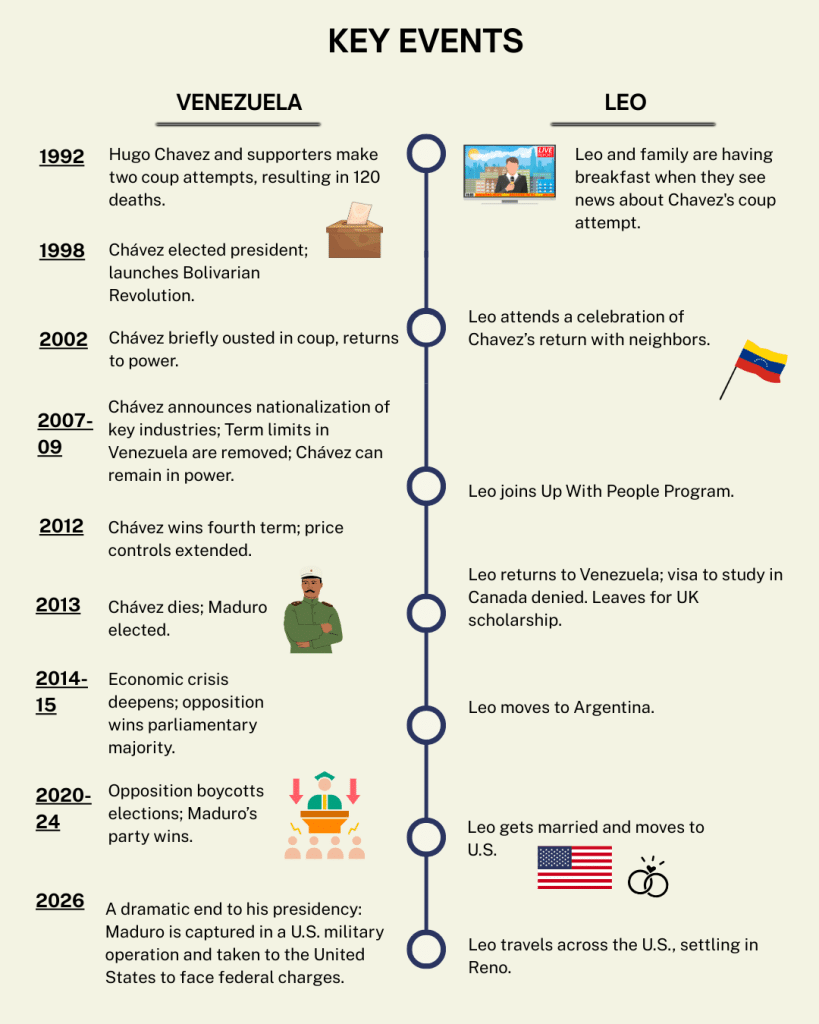
“I remember vividly, 1992, when [Chávez] tried to do a coup of the president at the time,” Davis said. “I was a kid [4 years old], we were having breakfast, and I remember seeing the big TV and his face.”
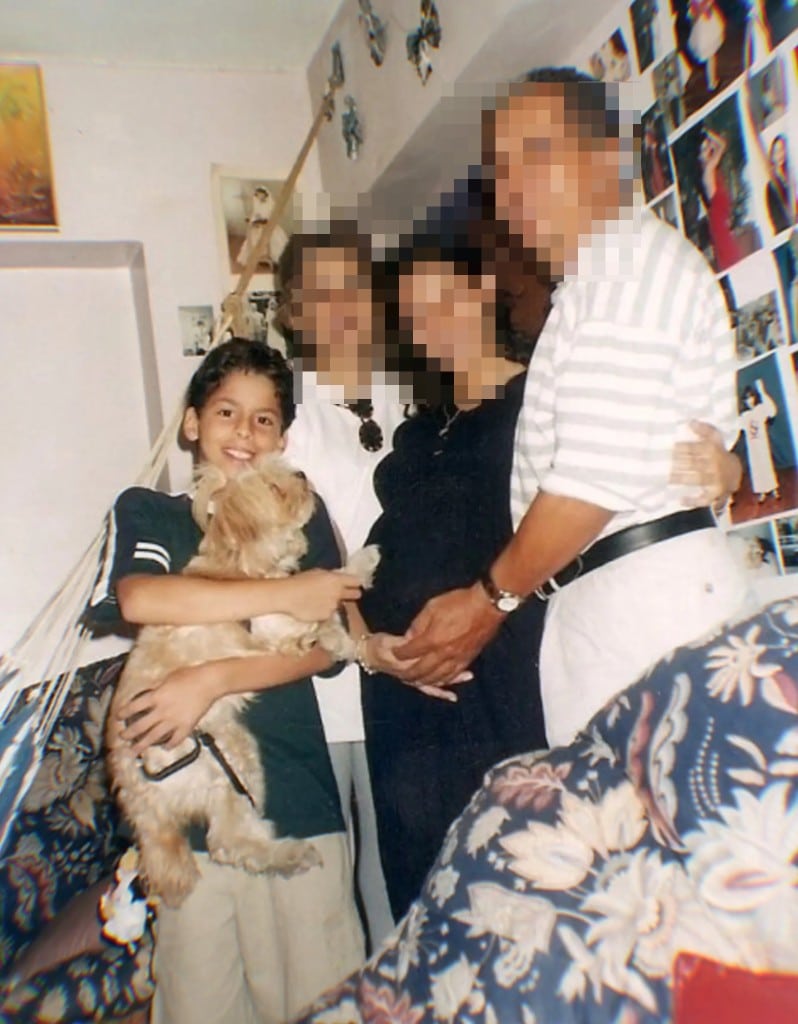
He was too young to understand the gravity of the situation, but knew something serious must have happened just from his parents’ reactions.
Throughout his childhood, Davis watched Chavez reinvent himself as a charismatic leader who promised to rescue Venezuela from a failing two-party system. When Chavez was elected in 1998, neighbors went out to celebrate and the unknowing Davis joined them.
“I was a kid,” Davis said as he remembered that day. “I didn’t know if it was good or bad…and now all the things that have happened, I’m like ‘wow.’”
None of them could predict the failure of Chavez’s social programs and the economic policies that would devastate the country.
A Family Under Pressure
Davis grew up in Venezuela’s capital, Caracas, the youngest of three children in a family that bet everything on education. He said his father went years without buying something as basic as new underwear so Davis and his siblings could attend private school.
At home, Davis’ mother became seriously ill at a time when public hospitals faced dwindling funding and equipment. His mother depended on an oxygen tank and constant medical care, and the family managed to piece together enough money for private treatment while living with rolling blackouts and water cuts.
“It’s going out every six hours, so you have to have a backup [oxygen machine] because you don’t know what’s going to happen,” Davis said.
Outside, Caracas was becoming one of the most dangerous cities in the world.
“It’s a natural way of events, right?” Davis said. “When you’re hungry, you’re trying to feed your family or yourself, you go and rob people.”
Chavez’s rule is marked by his fierce support of social programs and at one point enjoyed a boom in Venezuelan oil production. But when Chavez died in 2013, Venezuela had witnessed over a decade of chronic monetary instability and continued inflation. In an effort to finance state spending, Chavez had devalued the nation’s currency, the bolívar, more than five times during his presidency.
“The money was worth nothing,” Davis said. “They tried to rebrand the bolívar into the ‘new bolívar;’ which was basically deleting a bunch of zeros off the bills to make you think that you are paying with one bolívar. But in reality, you’re paying a million.”
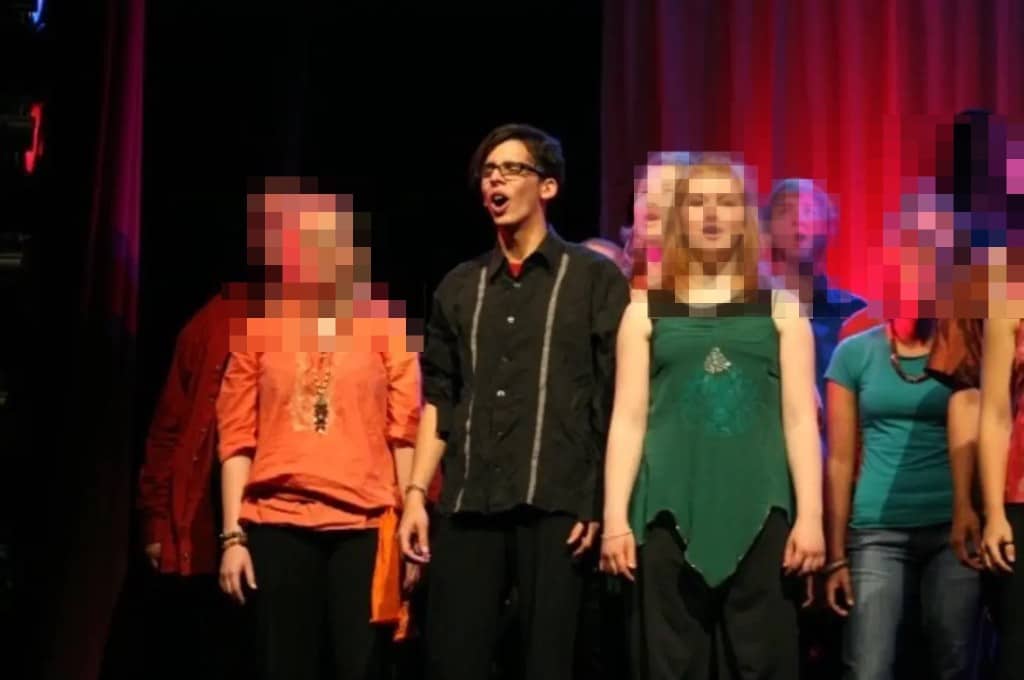
Davis’ older brother, who was 15 years old at the time, was able to escape these conditions first through the Up With People music program based in Colorado. During the program, Davis’ brother joined young people from across the globe to perform and raise money for community initiatives.
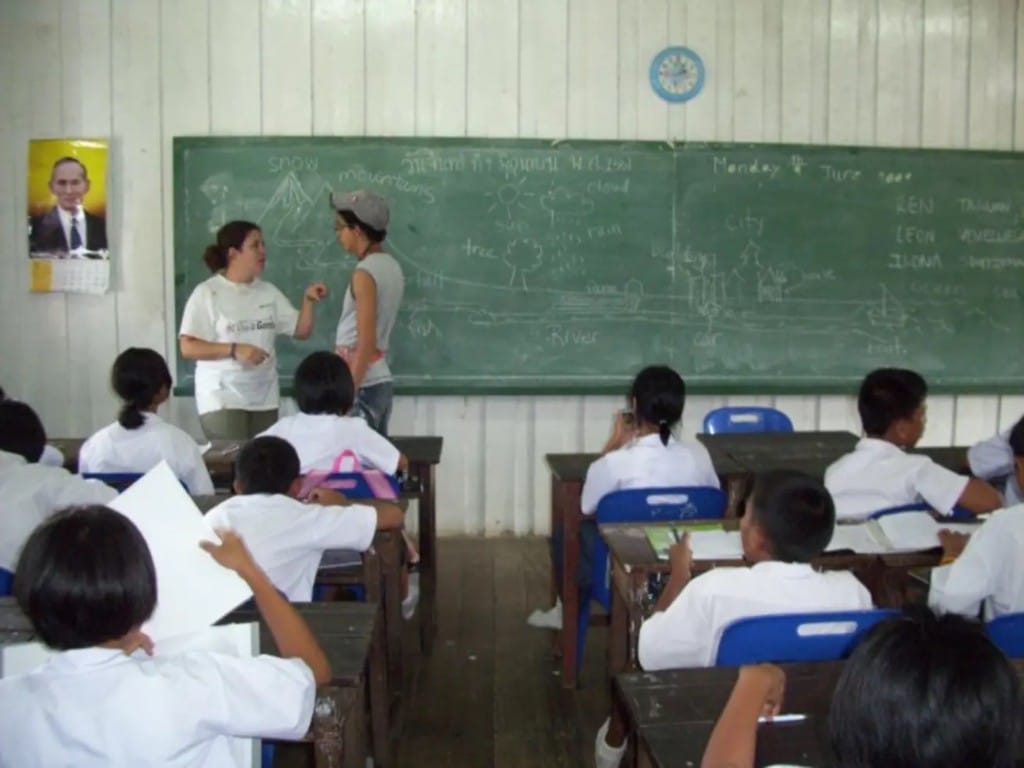
In 2007, after his mother passed, Davis was able to join the program with his brother’s help. Through the program, Davis traveled across the United States for community service projects, to Mexico to perform in a choir, and to Thailand to teach English.
“You really get perspective,” Davis said. “Everything that I lived through and that I know of is only one aspect of this big world.”
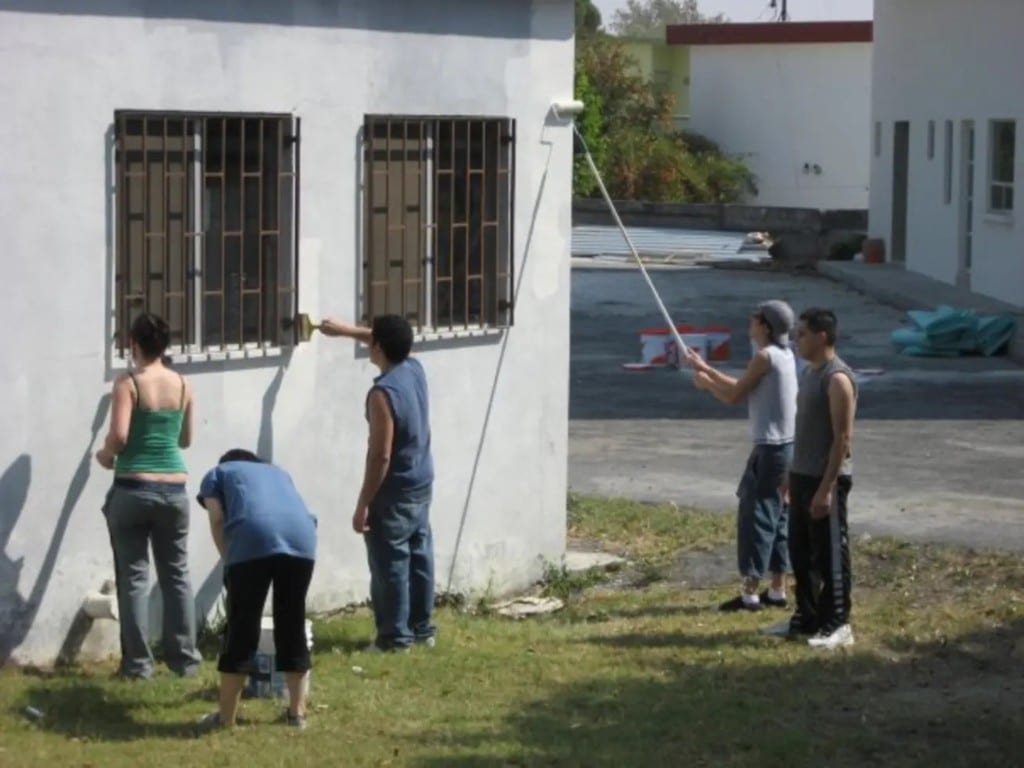
After the program, Davis planned to study in Canada, but when he went back to Venezuela to complete travel paperwork, his visa was denied. It took a toll on him.
Davis wanted to forget about the pain and struggle that he had faced growing up, and was afraid that he would never be able to leave again. With the help of his family and people he had met through the Up With People program, he had another opportunity to leave in 2009.
“I was able to get a scholarship to go to the [United Kingdom],” Davis said. “I was studying advertising [in Venezuela at the time].”
On the eve of Davis’ flight to the UK, Davis’ family went to the bank to collect the funds they had painstakingly saved for his departure. Someone inside the bank had tipped off robbers that the family was leaving with cash in hand.
“We were followed from the bank by these guys in scary suits and motorcycles,” Davis said. “They held their guns on us and took the money.”
The challenges to leave didn’t end there. At the airport, military personnel stopped and searched travelers. They searched bags, stole, and stabbed through shoes to allegedly search for drugs.
“I went to a new country with no money, with holes in my shoes,” Davis said.
Surviving Apart
Abroad, Davis survived by working under a student visa and applying for scholarships. His father and sister remained in Venezuela for years, living through deepening shortages and insecurity.
“I feel like we were all trying to survive,” Davis said. “Communication wasn’t the greatest.”
Even through scattered photos and Skype calls, the crisis was visible.
“I think that the hardest part for me was seeing things get worse to the point where there’s no food,” Davis said. “I saw my dad, a pretty chunky guy, become super skinny and I was like, ‘this is terrifying.’ My uncle and his girlfriend, and the people around them are just struggling to find the basics.”
His family did eventually leave Venezuela, but they’re now scattered across the globe. Family check-ins and Christmas gatherings now happen over FaceTime.
“For many Venezuelans, I feel like that has been the norm for so many years,” Davis said.
“Hands-On Democracy” not “Hands Off Venezuela”
Venezuelans have struggled to change their country from within. Years of protests and elections all seemed to do nothing against Chavez’s, then Maduro’s, reign.
“When no change happens, you get defeated and numb to it,” Davis said. “I understand how it feels when you are so exhausted about the politics, and you don’t even want to know because you are just trying to live day by day.”
Even when opposition forces won a landslide election in 2024 with Edmundo González on the ballot, Maduro remained in power and González went into exile.
That’s why when Maduro was captured in January, Davis felt that mixed sense of relief and anxiety about what would come next.
“For many years we didn’t get the help [from democratic neighbors or humanitarian organizations],” Davis. “We didn’t get it from any other neighbors until now.”
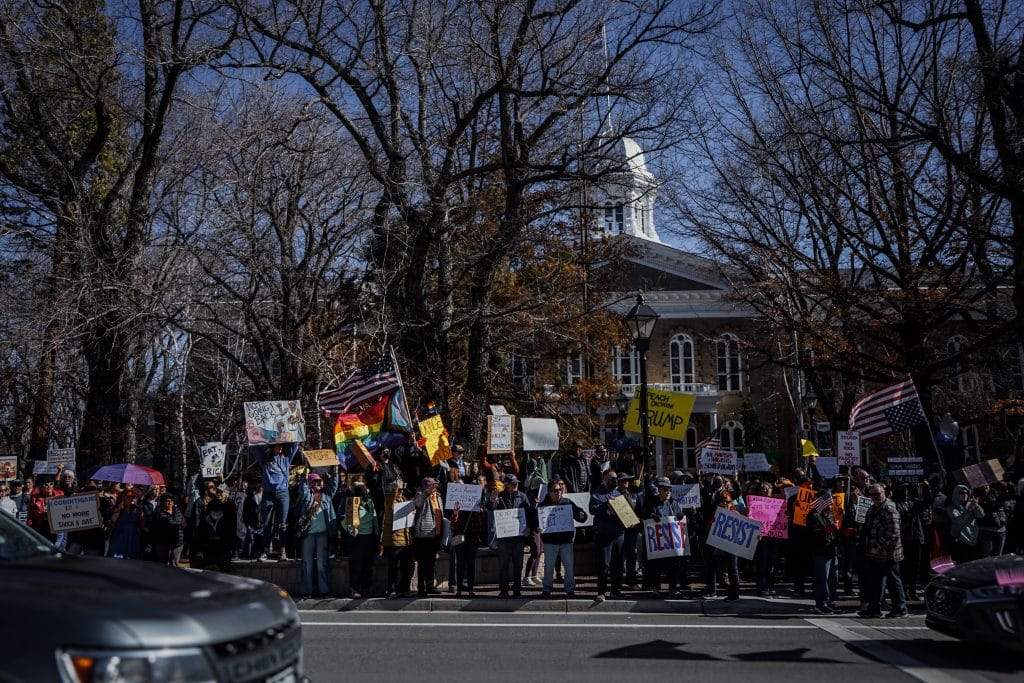
Davis calls “Hands Off Venezuela” protesters well intentioned and acknowledges that there are “absolutely” other interests the United States is pursuing with their involvement in Venezuela.
Like some Venezuelans across the globe, Davis is instead calling for a “hands-on democracy” approach. With no trust in the Venezuelan government and no systems of transparency, the country needs support from the United States, Davis said.
The closest comparison of the United States’ intervention in Venezuela with another Latin American country is Panama, said Renata Keller, a historian specializing in U.S.-Latin American relations at the University of Nevada, Reno.
“The United States invaded [Panama] in 1989 to remove Manuel Noriega from power,” she said. “He was a self declared leader of Panama.”
When the United States removed Noriega from power, he was indicted with similar charges to Maduro, including drug trafficking. Shortly after, at the request of the United States, opposition leader Guillermo Endara was sworn in as president and democracy returned to the nation.
“I don’t think we’re seeing that yet in Venezuela,” Keller said. “Panama is a relatively small country, whereas Venezuela is a relatively big country, so any sort of intervention or military occupation in Venezuela is going to be much more difficult than it was the case in Panama.”
If President Donald Trump is interested in bringing democracy to Venezuela, Keller said he would be working with Nobel Peace Prize winning opposition leader María Corina Machado. Instead, the interim presidency has gone to Maduro’s former vice president, Delcy Rodríguez.
The Trump administration wants to take control of the country’s oil industry, according to a Bloomberg article, but U.S. intelligence reports indicate doubts about Rodríguez’s full cooperation with White House demands, including cutting ties with close international allies like Iran, China and Russia.
“I think Venezuela is in dire straits,” Keller said. “ All we’ve done is remove its president without making any changes at all, and so the Chavista leaders are still in power. There’s just a different leader now with the same approach.”
Davis believes that Venezuelans need to organize and continue forward with a sense of urgency to enact the change they want to see. He said freedom happens when the people advocate for it and work for it.
“It would be up to us all in the region of the Americas to elect people we hold accountable to ensure we are building prosperous and actually free communities,” he said.
A Lesson for the World
Davis said that today, he sees a lot of parallels between the United States now and what led up to this point in Venezuela.
“It gives me goosebumps,” he said. “Look what happened to my country, and I definitely don’t want that happening here.”
Davis said he hopes his story can bring perspective on what’s happening in Venezuela–and the United States today. He encourages people to find the Venezuelans in their community and listen to what they have to say. Not just students, but doctors and lawyers who, after leaving Venezuela, might be cleaning toilets to survive.
“I encourage people to seek perspective and identify patterns [between the U.S. and Venezuela],” he said.
For those looking to deepen their understanding of Venezuela’s history and U.S. intervention, Keller provided an introductory reading list on the history of the United States in Latin America and Venezuela on Bluesky.
Republish our stories for free, under a Creative Commons license.
Author
Related Articles

It Could’ve Been Me
The tragedy in the backcountry outside of Truckee is a reminder to not judge too quickly and reach out to those close to you
As ICE agents flood Minnesota, local reporters say national news misses the mark
Recent New York Times reporting on a Minnesota scandal may have cast unwelcome attention to the state’s Somali community, but it isn’t the first time national journalists haven’t captured the full scope of Minnesota’s local stories.
Public Space and Civic Identity in the Mountains: Truckee Debates Its New Library
Despite overwhelming public support, a funding measure for a new library has led to contentious arguments around its financing and place in the community.
Comments (0)
There are no comments on this article.