
The Realities of Our Rapidly Changing Immigration Landscape
While most immigrants come to the United States legally, one Reno-based immigration attorney says doing things “the right way,” is complicated, expensive and full of roadblocks.

As a bike commuter, Kyle Edgerton spends his mornings navigating the hills and curves around Reno to get to the office. It’s during these rides he likes to think through new ways of solving work issues. As an immigration lawyer in Reno, one major challenge is figuring out how to help more people make sense of the country’s complicated immigration system.
“The immigration system takes about five minutes to explain and about 30 seconds to lie about,” he said.
Edgerton has been practicing immigration law in Northern Nevada for 15 years. During this time, he has seen the pendulum of immigration policy swing from one side of the political spectrum to the other, and he has noticed that any attempt at bipartisan solutions often gets lost in the game of politics.
“That’s a big problem for us,” he said. “It’s obviously a major political and policy issue that we’re confronting.”
Helping more people make sense of the system is an uphill climb. That’s because many Americans drastically misunderstand the reality of immigration in this country. A Pew Research study reveals that while 61% of college-educated adults know that most immigrants are here legally, 38% of those without a college degree are aware of that fact.
The truth is nearly three out of four immigrants in the United States are here lawfully — as naturalized citizens, permanent residents, or temporary visa holders. Only about one in four are undocumented.
The problem isn’t just policy — it’s perception.
“It’s difficult to get a politician to adopt a position on an issue when his or her political well-being depends on making that issue interminably unsolved,” Edgerton said.
Edgerton believes a key to bettering our immigration system is getting Americans to understand its intricacies. In the face of mass amounts of misinformation, this is not always easy.
But with the spotlight on immigration over the last year, with the Department of Homeland Security and Immigration and Customs Enforcement a hot political topic, there seems to be a growing shift in the outlook on immigrants.
According to an October 2025 study by the Chicago Council on Global Affairs, 36% of Americans now view large numbers of immigrants and refugees as a critical threat to the country — a significant drop from 50% in 2024. Could this positive shift be because more people are educating themselves on our complex immigration system?
“That’s something folks reading this, who are not directly affected by immigration policy, could do. They should keep their ears open and find opportunities to educate themselves about how things actually work,” Edgerton said.
In reality, the system is complex and can take some years to navigate, making the path to entering the U.S. legally fraught with challenges and the path to citizenship even more perilous.
Filing for things like visas and green cards costs thousands of dollars, and that is before fees for immigration lawyers like Edgerton. Immigration forms are dozens of pages long, and a minor mistake could lead to delays in a case – or worse. Timelines for approval or denial are unclear, and Edgerton said it could take anywhere from six months to more than 20 years to resolve prior immigration violations or wait for visa availability.
Add to this the current climate around immigration and deportation — where images of a federal agent pushing a woman to the ground inside immigration court circulate in seconds online — and it becomes clear just how emotionally brutal the process can be for immigrants, even for those immigrants doing things “the right way.”
To understand our current situation, it’s helpful to look back for some answers and context.
A Country Founded on Immigrants
According to the Library of Congress archives, nearly 12 million immigrants came to the United States between 1870 and 1900. Many of these newcomers came from Europe seeking freedom from political or religious persecution. Despite current viewpoints on immigration, during this time states worked to lure more immigrants through the promise of jobs or land.
These early efforts helped spur the economy, at least for those already here. A study by the Harvard Business School stated that during mass migration during the early 1900s, “a growing economy fueled by immigration created new jobs and employment opportunities for native-born men.”
A series of laws followed in the century ahead that would further define how the immigration system would be built – and who would be given priority.
A Brief History of U.S. Immigration Policy
The Naturalization Act of 1790 was the first to specify who could become a citizen, limiting that privilege to free whites of “good character” who had lived in the U.S. for at least two years.
In 1875, the first restrictions on immigration were enacted. During this time came a policy directly targeting immigrants based on their nationality, culminating in the Chinese Exclusion Act of 1882, which barred Chinese from entering the U.S.
In the early 20th century, the Johnson-Reed Act was passed imposing numerical quotas based on immigrant nationality, favoring northern and western European countries. Those quotas were later increased for Europeans outside of Northern and Western Europe with the passage of the Immigration and Nationality Act of 1952, which is the framework for the U.S. immigration system today.
The 1965 Immigration and Nationality Act erased national-origin quotas, created a preference system for prioritizing immigration (favoring family relationships), and prohibited discrimination based on “race, sex, nationality, place of birth, or place of residence.” While the act made it easier for some to immigrate to the U.S., it still had discriminatory factors.
The law for the first time placed caps on immigration from the Western Hemisphere, and the new priority system that favored existing family connections meant there was a higher demand for visas for family members of those already in the U.S., and fewer visas available for them. Edgerton said that law ultimately led to a backlog of immigrants from countries with historical high in-migration numbers–China, India, Mexico and the Philippines–which has only recently started catching up over the last decade.
Immigration rules were tightened with the Illegal Immigration Reform and Immigrant Responsibility Act of 1996, which ordered deportations for undocumented immigrants and imposed a penalty, forcing them to remain out of the country for years. Edgerton said this policy stripped discretion and reduced access to federal courts, and that the “tough on immigration” approach made it harder for those who violated laws to start over.
This followed the Clinton administration’s Operation Gatekeeper, which emphasized a “prevention through deterrence” strategy that militarized the border, increased detention space, and built new walls.
With immigration still a top political point for both major parties, and with all of this history in mind, is there a bipartisan solution?
“We actually have a pretty darn good blueprint sitting on the shelf. It was the 2013 bill, the Border Security, Economic Opportunity, and Immigration Modernization Act,” Edgerton said.
That bill offered a pathway to citizenship for undocumented immigrants who arrived before December 31, 2011, granting them Registered Provisional Immigrant (RPI) status with eligibility for a green card after ten years and citizenship three years later.
It tied this process to significant border security investments, including thousands of new agents and surveillance technology.
The bill also included a fast-track to citizenship for DACA-eligible youth, mandated nationwide E-Verify to curb illegal hiring, and modernized legal immigration by clearing visa backlogs and creating new merit-based and worker visa programs.
According to Edgerton, it was truly a bipartisan bill that saw investments into both broader immigration security measures, while also streamlining the immigration process.
Despite passing with a filibuster-proof margin of 68-32 in the Senate, that 2013 bill never saw a hearing in the Republican-controlled House of Representatives, and effectively died.
As it stands today immigration policy seems to be getting further away from bipartisan solutions, like the Border Security, Economic Opportunity, and Immigration Modernization Act, leaning more toward theatrics and harsh policies that make things more complicated for immigrants and lawmakers alike.
A “Nightmare Flow Chart”
Today, immigrants to the U.S. face an uphill battle, if they’re allowed to enter the country at all. For example, people from 19 countries, many of whom are dealing with national crises, face a travel ban, and in December, the Trump administration took this even further with a drastic measure pausing all immigration proceedings for these 19 countries including citizenship ceremonies and green card interviews–leaving upwards of a million people affected by these new changes confused and fearful about the path ahead.
On top of this people from these 19 countries can no longer get visas to enter the U.S. for things like study or work.
Visas are documents needed for those from another country to live in the U.S. permanently (immigrant visa) or to be in the U.S. temporarily for medical, travel, business, or study purposes (nonimmigrant visa). According to the U.S. State Department, there are more than 20 types of nonimmigrant visas, and there are several types of immigrant visas. According to current immigration law, the U.S. can allow 675,000 permanent immigrants every year across the various categories, with additional admissions for relatives of those granted visas.
Yet, those visa categories contain several scenarios and nuances that could either allow or deny someone a visa. Edgerton calls the system a “nightmare flow chart” and said for example, marrying an immigrant isn’t a guarantee they would get legal status.

“The immigration system is complicated; it’s difficult to know where to start, and it’s difficult to understand how to prosecute some applications for benefits that you might qualify for, and so people say, ‘Well, I’m going to go to an immigration lawyer,’” he said.
There are fewer than ten practicing immigration lawyers in Reno, and their fees are high. So access becomes a huge problem for many looking to start the legal immigration process.
“There’s only a handful in our region. Because availability is limited or because the prices seem high, they’re going to turn somewhere else,” Edgerton said.
The hope is that these people turn to reputable organizations like Catholic Charities, which offer free immigration help. Still, sometimes immigrants can become victims of scams, spending thousands for legal assistance from someone unauthorized. Specifically, Edgerton said notaries or notarios should not be used as legal aid.
All of this is to say the current immigration system in the U.S. is complicated, and prioritizes certain groups while restricting others. The current focus on restricting immigration and rounding up “illegals” is leading to an overly-simplified focus on enforcement, with the American Immigration Council reporting that Immigration and Customs Enforcement (ICE), “has a budget larger than the Federal Bureau of Investigations (FBI), Drug Enforcement Administration (DEA), Bureau of Alcohol, Tobacco, Firearms and Explosives (ATF), U.S. Marshals Service, and Bureau of Prisons combined.”
Regardless of the history, a path forward on immigration will take time, effort and political will to make it happen. For Edgerton, while the politics play out and ICE becomes more dominant in our communities, the immigrants will be the ones shouldering the weight of our broken systems.
“These issues are complicated, and they’re complicated to understand, they’re complicated to figure out what the right policy choice is, and they’re also complicated to implement,” he said.
Republish our stories for free, under a Creative Commons license.
Author

Related Articles

As ICE agents flood Minnesota, local reporters say national news misses the mark
Recent New York Times reporting on a Minnesota scandal may have cast unwelcome attention to the state’s Somali community, but it isn’t the first time national journalists haven’t captured the full scope of Minnesota’s local stories.

Public Space and Civic Identity in the Mountains: Truckee Debates Its New Library
Despite overwhelming public support, a funding measure for a new library has led to contentious arguments around its financing and place in the community.
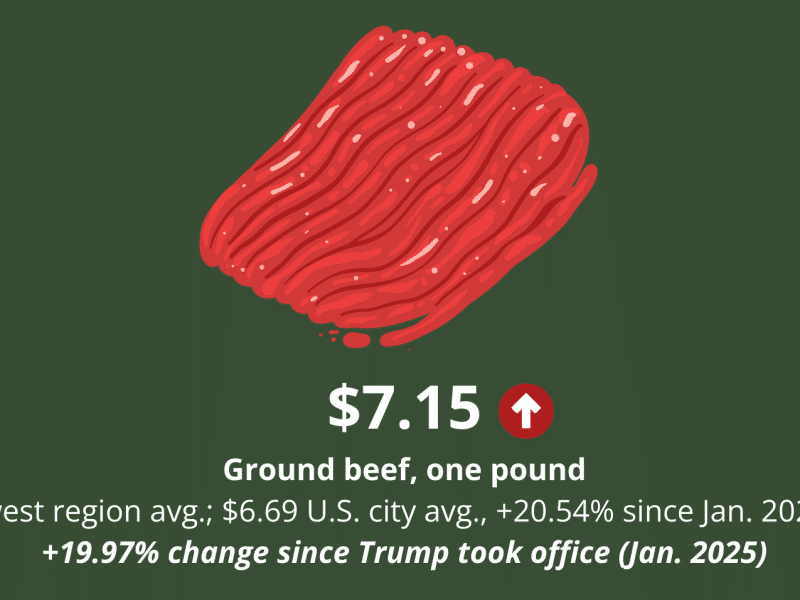
Tracking Food and Gas Prices in the Trump Era (Updated for December)
President Donald Trump campaigned on the promise of lowering grocery prices for everyday Americans. We’re tracking how that’s going.