
Freebirds
A Thanksgiving lesson in forgiveness
The Sierra Nevada Ally is a nonprofit organization that relies on community support to operate. It’s why we’re asking you to give now during our year-end fundraising campaign, where your donations (up to $1,000) are matched by our partners at NewsMatch.
This essay was originally published in Orion, a magazine on nature and culture, and a portion of that is being republished here with the author’s permission.
Read the entire essay at Orion Magazine’s website.
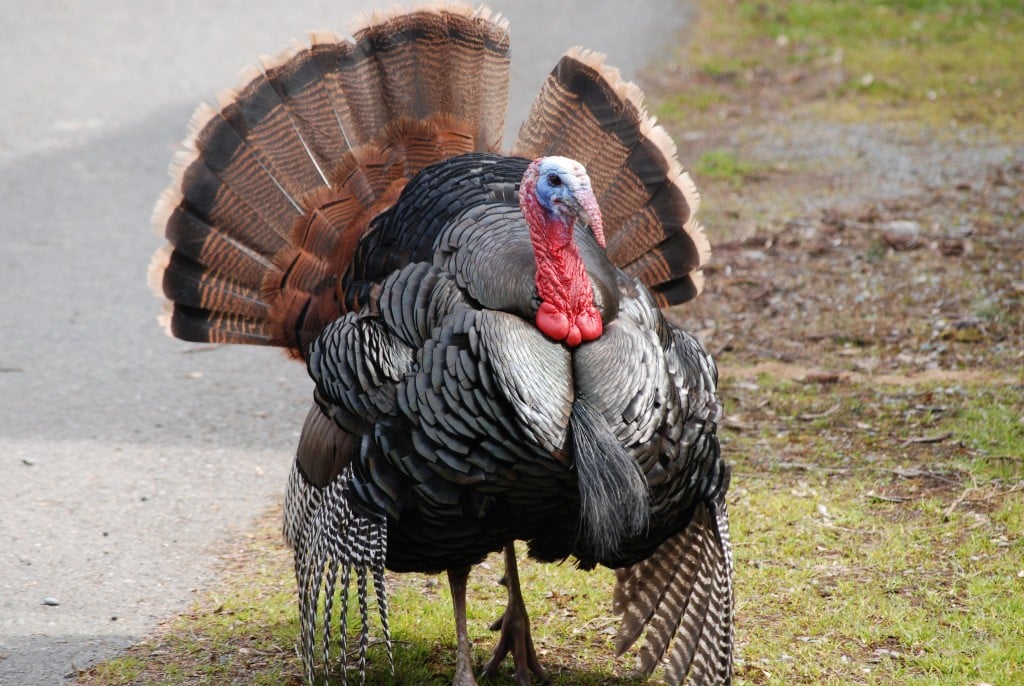
A few days before Thanksgiving, my wife, Eryn, came home from town with our two young daughters, both of whom had been administered the traditional Thanksgiving myth at school that day. Three-year-old Caroline was as proud as could be of her paper turkey, made from a cut-out drawing of her own little hand. And Hannah Virginia, our loquacious six-year-old, began blurting out her holiday lecture the moment she came through the door: “Dad, I bet you didn’t know that Thanksgiving comes from the Pilgrims and the Indians helping each other a bunch and then having a peace party and eating a really big supper with crazy-colored corn and turkeys and those turkeys were wild!” With this she donned her construction-paper Pilgrim hat with its big, fake buckle and gave me a huge smile.
I took a long sip of my whiskey and tried to formulate a response. The Thanksgiving feast the girls had learned about did in fact occur — at Plymouth Plantation in 1621 — but by the following year violent conflict between colonists and Native Americans had already erupted, and devastating Indian wars soon swept New England. There weren’t many turkeys shared at Mystic River in 1637, for example, when the Pilgrims burned and hacked to death at least four hundred Pequots, mostly women and children, as they slept. The Pilgrim leader William Bradford — who had actually been present at that much-celebrated first Thanksgiving — had this to say about the slaughter: “It was a fearful sight to see [the Indians] thus frying in the fire and the streams of blood quenching the same, and horrible was the stink and scent thereof; but the victory seemed a sweet sacrifice, and [we] gave the praise thereof to God.” Just as I was pondering how best to explain this genocide in a way that might somehow be compatible with the ennobling concept of Thanksgiving the girls had learned at school, Hannah pointed excitedly at the muted TV behind me and shouted, “It’s turkey time!” I turned to see that the news had given way to the image of a large, white turkey. A turkey at the White House, in fact. A turkey that was about to receive a formal pardon from the president of the United States.
For many people, Thanksgiving is about bringing together family and friends; for some, it is centered around the ancient autumnal harvest festival; for others, it is an opportunity to count and express our most precious blessings; for yet others, it is a holiday devoted to copious amounts of football and alcohol. I believe deeply in all these versions, but for me Thanksgiving is very much about the pardoning of turkeys.
The tradition of the presidential turkey pardon is wonderfully rife with distortion, ambiguity, and error — as all good stories should be — but what is most perplexing about this bizarre ritual is our uncertainty about its origins. Some claim that the turkey pardon began with President Lincoln, who, hoping to promote national unity amid the social fragmentation of the Civil War, did in fact declare our first official day of national thanksgiving in 1863. That same year Lincoln’s ten-year-old son, Tad, so the story goes, became so attached to a Christmas turkey that the president relented and agreed to spare “Jack” from the family table. More common is the claim that Harry Truman was the first president to save a turkey, but while Truman was indeed the first commander in chief to receive a holiday gift bird from the National Turkey Federation — a custom begun in 1947 and continued to this day — the evidence suggests that Truman, like most presidents who followed him, hadn’t the slightest compunction about eating his gift. It was President Kennedy who first broke with his predecessors by declaring, just four days before he was assassinated, that — despite the sign reading GOOD EATING that the Turkey Federation had hung around the bird’s neck — he would let his fifty-five-pound gobbler live.
This essay was originally published in Orion, a magazine on nature and culture, and a portion of that is being republished here with the author’s permission.
Read the entire essay at Orion Magazine’s website.
Republish our stories for free, under a Creative Commons license.
Author

Related Articles

It Could’ve Been Me
The tragedy in the backcountry outside of Truckee is a reminder to not judge too quickly and reach out to those close to you

Wild Christmas Pinyon
While you might imagine that artificial Christmas trees may be traced back only as far as the glory days of plastic in the 1950s, people actually began making fake holiday trees in the mid-nineteenth century.
Can an Opponent of Public Lands Safeguard Them for Us?
If Bureau of Land Management Director Nominee Steve Pearce gets the job, it would be like a fox guarding the hen house