
The Boxes We Build, Part II: A Cell Within the System
From one man’s cell to a nation’s policy, how solitary confinement reveals the true nature of American punishment.
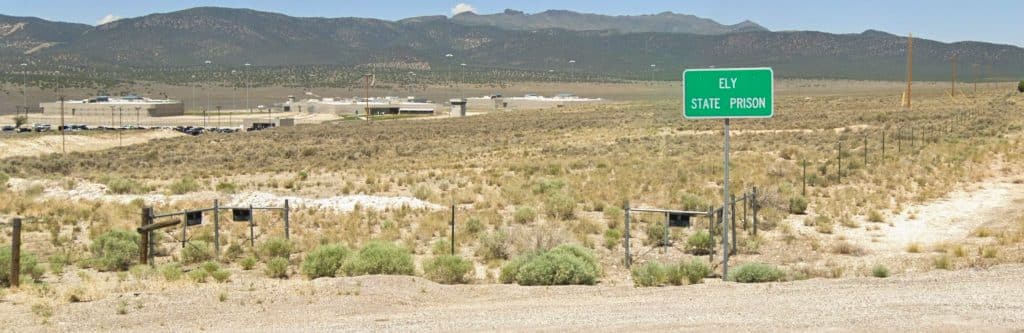
In Part 1 of this series, we met Frank De Palma, a man who spent 22 years in solitary confinement at Ely State Prison. Though Frank’s story is harrowing and singular, it is far from unique.
It stands as a stark window into a broader system—one driven less by rehabilitation than by erasure. Now, we widen the lens to examine solitary confinement itself, a practice not limited to Ely, but embedded in prisons across Nevada, the United States, and the world. A method with deep historical roots, devastating consequences, and a growing movement to bring it to an end.
America: Leader of the Free World—and of Solitary
Solitary confinement goes by many names: “Special Housing Unit” (SHU), “disciplinary segregation,” “restrictive housing,” “the box,” or simply “the hole.” While there is no universally agreed-upon definition, it is commonly understood as the physical isolation of individuals for 22 to 24 hours a day, often in windowless cells, with little or no meaningful human contact and severe sensory deprivation.
The United States is the only Western industrialized nation that relies heavily on long-term solitary confinement. According to the nonprofit watchdog group Solitary Watch, experts estimate that around 80,000 people are held in solitary in U.S. prisons on any given day—a number that rises to approximately 123,000 when jails are included. But even those figures are just estimates; the true number is difficult to track due to lax oversight and the many forms that isolation takes across correctional systems.
As of 2019, Nevada held the highest percentage of its incarcerated population in solitary confinement, with more than a quarter of its inmates placed in restrictive housing.
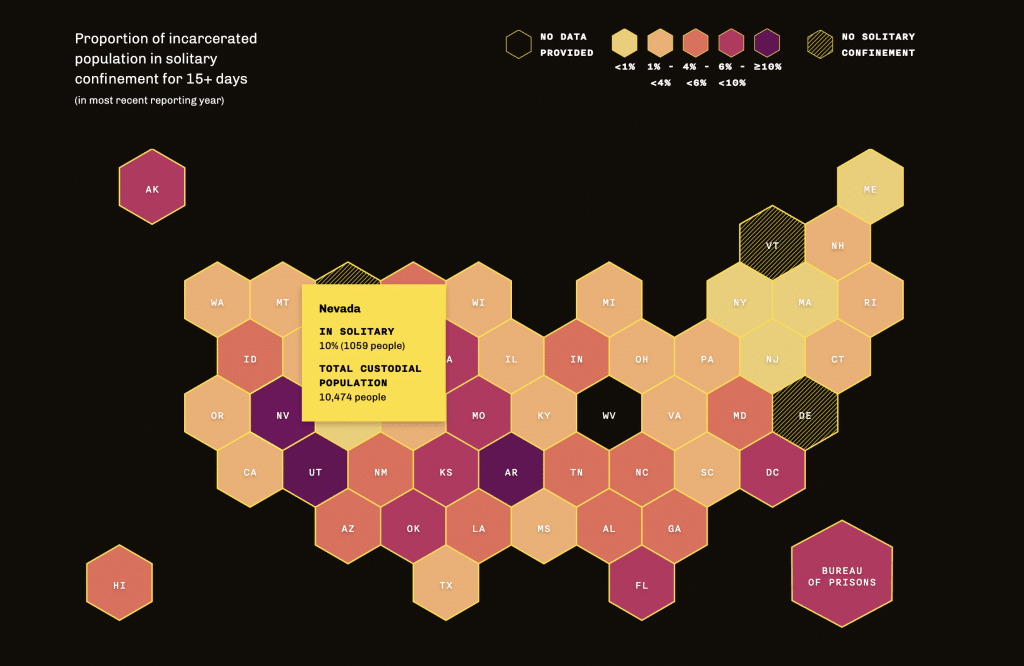
Frank’s story is emblematic of a distinctly American phenomenon: no country on Earth uses long-term solitary confinement more than the self-declared leader of the free world.
The practice didn’t always exist at this scale. The widespread use of solitary confinement exploded in the last few decades, fueled by the rise of “tough-on-crime” politics and the construction of super-maximum-security facilities—or “supermax” prisons—designed to control inmates through near-total isolation. Before 1990, supermax units were rare. Today, they are used by more than 40 states and the federal government.
Between 1995 and 2000, the growth rate of inmates held in solitary confinement outpaced that of the general prison population by more than 10%. The expansion was especially evident out West. In California, Pelican Bay State Prison—built in 1989 as the state’s first supermax—quickly became one of the country’s most notorious symbols of isolation-based incarceration.
The Human Cost: Solitary Confinement as a Public Health Crisis
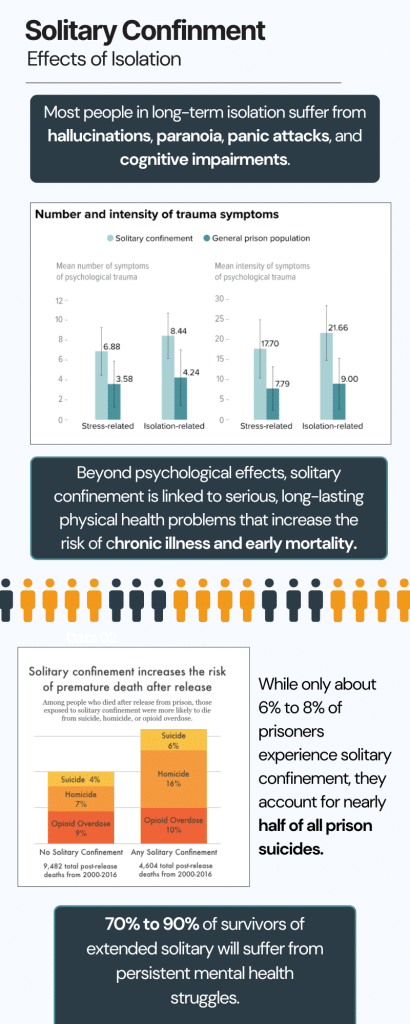
The consequences of solitary confinement are dire and well-documented. Physical and social isolation, coupled with sensory deprivation and forced idleness, create a toxic combination.
“The very experience of prolonged solitary confinement is one of sensory deprivation and social death,” said Professor of Political Philosophy and Critical Prison Studies Lisa Guenther. “It can erode cognitive clarity, emotional stability, and the capacity for social interaction.”
The Myth That Harsher Punishments Make Us Safer
Many believe that long, brutal prison sentences deter crime—but research shows the opposite. A 2016 National Institute of Justice review found that longer sentences have little impact on crime reduction. In fact, incarceration often has a “mildly criminogenic” effect, making people more likely to reoffend after release. Solitary confinement, in particular, erodes the social and coping skills necessary for life outside prison, leading to higher recidivism rates.
Harsh conditions don’t just fail to deter crime, they actively make communities less safe. Poor prison living standards damage physical and mental health, reduce the chances of successful reentry, and strain both families and public health systems. Incarcerated people often face untreated medical issues, malnutrition, unsafe water, and extreme temperatures—and those subjected to solitary confinement suffer even more acutely. These conditions can lead to lasting trauma, and create barriers to employment, housing, and stability.
“It isolates people at their most vulnerable and then expects them to return to society as a whole,” said Dr. Breea Willingham.
A professor of sociology and criminology and editor of Punishment and Society, Willingham has spent years studying what incarceration reveals about the culture that sustains it—not just as policy, but as belief.
The result? Individuals who are more psychologically unstable and less equipped to function in the community.
Isolation Isn’t Inevitable
Some form of short-term isolation is used almost everywhere as punishment for breaches of prison discipline. However, excessive use of solitary confinement in prisons around the U.S. is becoming an increasing concern.
While American prisons routinely subject people to years—sometimes decades—of isolation, European prisons, by contrast, keep the practice tightly restricted.
The European Union recognizes the severe mental health impacts of prolonged isolation and its damage to successful reintegration. The practice is limited to the shortest possible duration and imposed only in “exceptional circumstances.” Even then, isolated prisoners “must be offered at least two hours of meaningful human contact per day…and be provided with reading materials and one hour of exercise.”
These systems are built on the principle that the purpose of incarceration is to restore both the individual and the community. And their results speak volumes:
Norway’s recidivism rate is as low as 20%, compared to 66% of released U.S. state prisoners who are rearrested within three years, and 82% within ten.
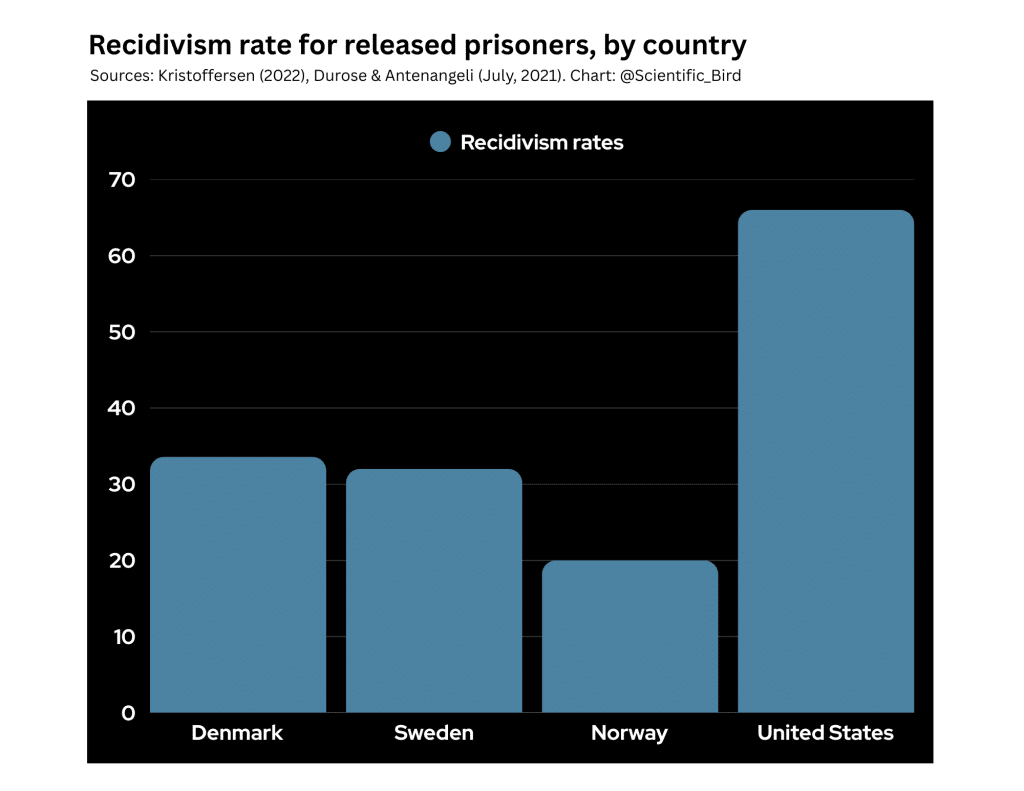
European prisons are designed for rehabilitation. What, then, is the goal of American prisons?
“Solitary confinement is a window into America’s punishment psyche. It’s about domination under the guise of safety,” said Dr. Willingham. “The very existence of long-term solitary confinement is a testament to how far we’ll go to disappear people rather than reckon with structural harm.”
If safer, more humane approaches are available—and proven—why does the U.S. cling to a system of isolation and torture?
Nevada Today: Reform or Rhetoric?
Frank De Palma served 22 years in solitary confinement at Ely State Prison, but multiple other state institutions in Nevada have also historically engaged in the practice.
The ACLU of Nevada and Solitary Watch’s Unlocking Solitary Confinement report documents the widespread use of long-term isolation across the Nevada Department of Corrections (NDOC). It reveals that NDOC has historically used solitary confinement for extended periods at multiple facilities, including Ely State Prison, Northern Nevada Correctional Center (NNCC), Lovelock Correctional Center, and others.
The Sierra Nevada Ally made multiple attempts to interview the Nevada Department of Corrections and the Nevada Department of Public and Behavioral Health, with no response.
NDOC’s Administrative Regulation (AR) 513 allows the use of solitary confinement for three purposes:
- Disciplinary segregation (assigned after a major rule violation through a formal disciplinary process)
- Protective segregation (separating an inmate for their own safety)
- Administrative segregation (for administrative necessity, such as security, safety, or investigations)
It’s worth noting that the regulation states, “solitary confinement is not to be used for the purpose of punishment.” The distinction, however, is largely semantic: the punishment is called disciplinary segregation, while solitary is treated as the housing assignment. In practice, people often end up in solitary because of disciplinary sanctions, no matter how the Department frames it. Even minor infractions—disobeying orders, causing disruption, swearing—can land people in restrictive housing, according to a 2021 Vera Institute report.
But Matthew Lowen, Associate Director of the Vera Institute’s Restoring Promise Initiative, says solitary confinement isn’t always formal or officially sanctioned, and is regularly part of a broader description of jail and prison isolation practices.
“There’s also the ad hoc or unofficial forms of isolation or solitary confinement lockdowns, where it’s either staff shortages or facility lockdowns for a myriad of reasons, and that could just result in people not being let out of their cells,” he told The Guardian in July.
Currently, no states in the U.S. bar the use of solitary confinement. However, a handful of states have recently considered or passed legislation to limit its use—Nevada being one of them.
In June 2023, Nevada Gov. Joe Lombardo signed Senate Bill 307 into law, which requires NDOC to implement the “least restrictive manner” when separating inmates from the general population, and doing so for the “shortest period of time safely as possible.”
While the bill’s passage signals positive change, advocates of prison reform remain wary of how exactly it is being enforced.
Nick Shepack, the Nevada State Director at the Fines and Fees Justice Center (FFJC), expressed concern that while policies like Senate Bill 307 may exist on paper, actual enforcement inside prisons is far harder to track.
“When it comes to implementing prison legislation—unless it’s something tied to money, like a commissary markup cap you can easily check—it’s really hard to know what’s happening day to day,” said Shepack. “The director can send down new policies, but whether rank-and-file guards are actually following them? That’s always been a major issue with any kind of prison reform. So I’m always concerned.”
As of publication, the NDOC and the Department of Public and Behavioral Health had not responded to multiple requests for comment.
Jodi Hocking, the founder of the prisoner advocacy group Return Strong, called SB 307 “a phenomenal bill that made historical strides,” but added there was still work to be done around understanding the use of facility lockdowns and other methods to segregate certain individuals.
“I just want to be clear that we are super ecstatic about the work that did happen, but there is still a long way to go,” Hocking said. “I don’t want it to seem like we’re done with it.”
Order or Trauma? What Solitary Really Maintains
Frank De Palma, the man who spent 22 years in solitary confinement in a Nevada prison, also holds hope for the legislation—though he remains skeptical.
“While the passage of the bill was a major step in the right direction there is still more work to be done. Advocates and legislators will need to monitor the law’s implementation and we must continue to talk about solitary and its impacts. The more people that understand this tortuous practice the quicker we will see its abolition,” he wrote in an op-ed for The Nevada Independent.
Frank’s experience in solitary—decades of sensory deprivation, silence, and psychological toll—is not a historical artifact. It’s a reflection of a system still very much in place. His story forces us to confront a central truth: Solitary confinement doesn’t maintain order; it manufactures trauma. Prisons justify solitary confinement as a last resort, but it’s often used as a tool of convenience or retaliation.
The existence and continued use of the practice forces us to confront an important question: what does our use of solitary confinement say about us, our values and our culture?
In the final part of this series, we explore what using solitary confinement—despite knowing its human costs—says about us as a society.
This work is made possible by Press Forward, a national coalition investing more than $500 million to strengthen local newsrooms and close longstanding gaps in journalism coverage. Donate to join the movement and support coverage on civics, climate and community in the Sierra Nevada region.
Republish our stories for free, under a Creative Commons license.
Author

Related Articles
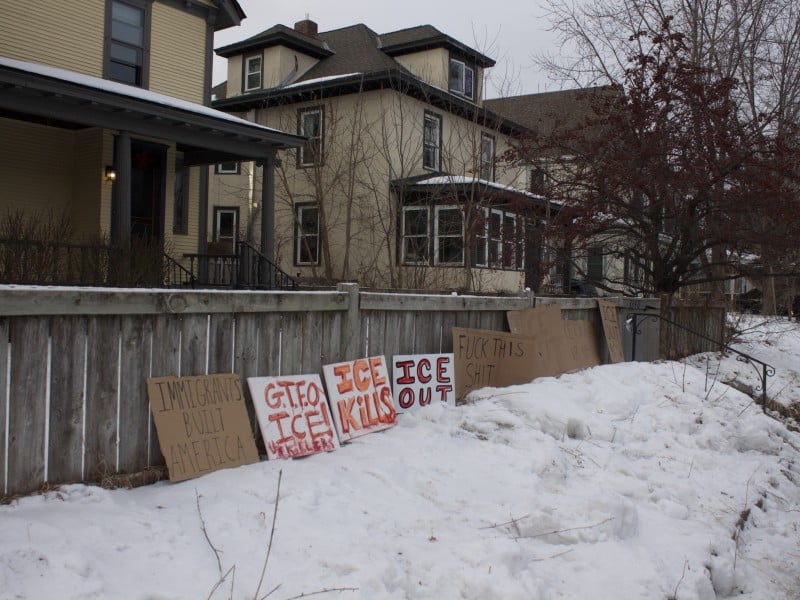
As ICE agents flood Minnesota, local reporters say national news misses the mark
Recent New York Times reporting on a Minnesota scandal may have cast unwelcome attention to the state’s Somali community, but it isn’t the first time national journalists haven’t captured the full scope of Minnesota’s local stories.
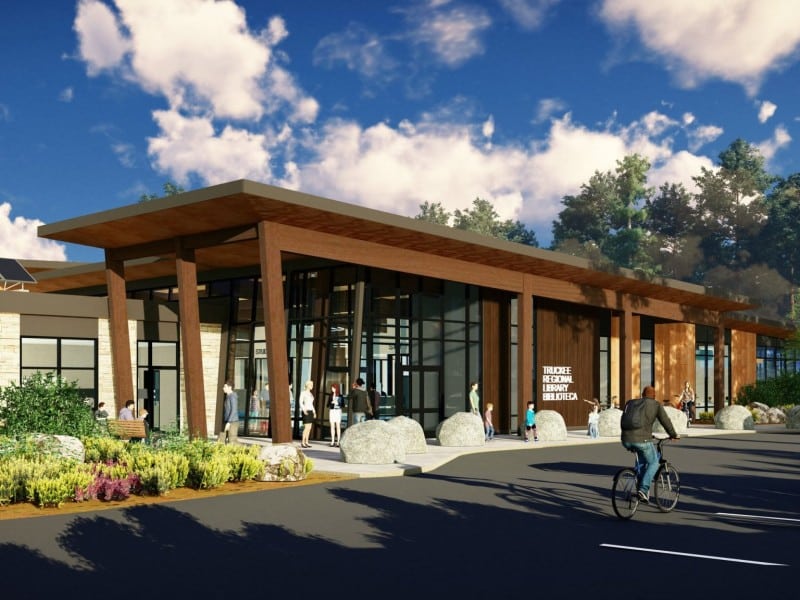
Public Space and Civic Identity in the Mountains: Truckee Debates Its New Library
Despite overwhelming public support, a funding measure for a new library has led to contentious arguments around its financing and place in the community.

Tracking Food and Gas Prices in the Trump Era (Updated for December)
President Donald Trump campaigned on the promise of lowering grocery prices for everyday Americans. We’re tracking how that’s going.