
Author Interview: Looking at the Impact of the Critical Minerals, in Nevada and Beyond
An interview with Ernest Scheyder, author of The War Below: Lithium, Copper and the Global Battle to Power our Lives

A new battleground is forming in the state of Nevada, where an influx of federal funding and state-level tax incentives are seeking to kickstart a critical mineral economy necessary to support the renewable energy transition. But while critical minerals provide foundational components to all of our electronic devices – from everyday technologies like cell phones and laptops, to renewable energy technologies like wind turbines and electric vehicle batteries – extracting them from the ground does not come without its costs.
Sierra Nevada Ally’s science and technology reporter, Scott King recently spoke with Ernest Scheyder, author of The War Below: Lithium, Copper and the Global Battle to Power Our Lives, about what the critical mineral economy means to the everyday Nevadan.
An excerpt of this interview, and an extended audio version, is below.
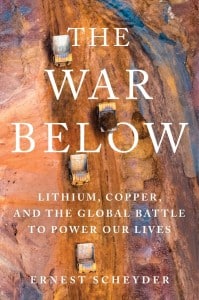
Ally: Ernest, thanks for joining me today. Can you describe the book and how the idea for it came about?
Scheyder: I have been chronicling for several years proposed mining projects across the United States and the world that would supply lithium, copper, nickel, cobalt and other critical minerals and metals for the energy transition. But, I began to notice that many of these projects faced opposition from folks for completely legitimate reasons, whether it was around Indigenous rights reasons, ecological reasons or other reasons.
Increasingly, when you have so many of those stack up, it brings up the question, ‘Where are we going to get these building blocks for these green energy devices, things that help us fight climate change, like solar panels, and wind turbines, but also gadgets that increasingly are used every single day, like cell phones, laptop batteries, etc?’
The book really is an exploration of the choice that we face, if we want this energy transition. ‘Where are the places that we’re willing to allow mines? What are the standards by which we want mines to operate? Are there some places too special to mine?’ The book looks at the humans that are on all sides of this issue and it is written for everyone, because it’s a topic that I firmly believe matters to us all.
Our audience is based in Nevada and the greater Sierra Nevada region. You spent a substantial portion of your book covering the Rhyolite Ridge and Thacker Pass projects. Given the prominent role that these projects play in your book, can you describe why you felt it was important to focus on these two tentative projects and the state of Nevada, in particular?
Nevada has a huge mineral resource, not just for gold and silver, but for many other critical minerals and metals that are so important for the energy transition. When I took a look at the Thacker Pass and Rhyolite Ridge projects, I wanted to include them, given the sheer size of the deposits that are there and the sheer potential to power this energy transition. [But] also the complexities that are involved in the permitting process for both projects that really helped encapsulate this idea of choice.
With Rhyolite Ridge, you got a story of one of the largest lithium deposits in the country. It’s commingled with boron, which is used to make soaps. Anytime you have two materials that you can develop at once, that’s great for investors and for companies, because you have two revenue streams – so you can see the potential right there. But the problem is that this deposit, which is about 200 miles north of Las Vegas, lies underneath a habitat for a rare flower found nowhere else on the planet. This is known as Thiem’s buckwheat. It’s a beautiful little flower, about six inches or so tall that blooms between May and June. It has these beautiful red seeds that help propagate the next generation.
But the question and the tension comes right away: can the mine and the flower coexist? Can you develop an open pit mine next to where this rare flower – found nowhere else on the planet – goes? And if not, does one matter more than the other? What are the choices we’re willing to make here? If we let this flower basically go under because of the mine’s development, what does that say about our approach – as humans – to biodiversity? If we did nothing and let climate change continue, would not the flower go extinct due to climate change? So, there’s a lot of really interesting questions that I want the audience to juggle with here by exploring the Rhyolite Ridge project.
Thacker Pass, which is on the Nevada-Oregon border, so farther north than Rhyolite Ridge, is actually the largest deposit of lithium in the entire North American continent. It’s extremely, extremely big, so you can see why it’s been such a big prize for such a long time.
The company has run into some opposition from local Native American tribes, as well as some conservationists and environmental groups that take a pretty stark approach to industrialization, they actually advocate for de-industrialization. They partnered with the Native American groups in the region to fight this project, including in court where they filed several lawsuits. So, I thought it was extremely important, especially given the prolific size of this deposit, as well as the multi-stakeholder opposition to it, to better understand the people and the issues at play there.
I really thought those two [mines] really helped bring the reader this idea of choice that I think is so crucial to The War Below’s key narrative, and helped people understand it better. Nevada plays a starring role in that narrative.
Then to take it a step further, there’s been a big push in the state of Nevada to close the “lithium loop,” or essentially, round out the lithium economy with not only mining of the mineral, but also processing, refining and recycling of it as well. Can you elaborate why it’s important to look at the broader economic implications, beyond just mining, for closing the “lithium loop” and the rest of the critical mineral economy?
In The War Below, I have a chapter looking at recycling and there’s two recycling companies in particular that I profile: one is Lifecycle, which is headquartered in Toronto, and another will be known to folks in Nevada – it’s JB Straubel’s Redwood [Materials], which is in the Reno area. Both companies take different strategic approaches to recycling. They each want to take end-of-life batteries and repurpose them for use in new batteries down the line.
It’s important to recycle in order to get to the idea of what’s known as a ‘circular economy.’ This is the concept that old cell phones, EV batteries or old wires and whatnot out there can be turned in, recycled and the metals inside can be reused. Unlike oil and natural gas, which after it’s used for combustion is burned off – these metals do not lose their ability to be used in batteries, once they’ve been sitting on a battery for say ten or 20 years. Lithium does not lose its ability to hold a charge just because it’s been in a Tesla for a few years.
If you can recycle those, it makes it very appealing in order to reduce your use of mines down the road. But when [will] we actually get to that tipping point [of] a circular economy? It is anyone’s guess – some say 2040, some say 2050 or beyond that – we just don’t know. We do know that we’re going to need mines for the foreseeable future. Then at some point, we’ll start to decrease our need to basically dig a hole in the ground and we’ll have to then focus a lot on recycling.
You’ve got some mining companies right now that are very interested in this [recycling]. Albemarle, for instance, is the world’s largest lithium producer and actually operates a facility in Nevada right now that produces lithium at Silver Peak. It has started to plan out a lithium refinery project in South Carolina that will include as part of its plans a recycling component. That has been on the drawing board for a few years down the road, but it just shows that the lithium industry is beginning to think about this potential of recycling and getting to a closed-loop concept.
Lithium tends to garner most of the attention when people think of critical minerals, but in this book, you made a noted effort to talk about other critical minerals – such as copper and rare earths – and how they support the whole critical mineral industry. Likewise, we’ve been seeing attention in Nevada drawn to the potential for nickel, cobalt, copper mining opportunities, even vanadium. So why is it important to look at the broader range of critical minerals, beyond just lithium, in order to support the transition?
Well, lithium, of course, is one of the key components of the energy transition, specifically because of lithium-ion batteries. Copper is in so much wiring, it’s in motors, it is really the anchor for a lot of this work. But, when you think of the petroleum-based economy that really defined the 20th century, I think people generally understand how petroleum is taken out of the ground, put it in a refinery and then you get gasoline or diesel or other end products out of there. With critical minerals, the production process is vastly diverse. How you produce lithium is much different than how you produce nickel. But a lot of batteries require both [minerals].
There’s a whole host of critical minerals out there that are not just what I would call ‘The Big Five,’ and those five are lithium, copper, cobalt, nickel and rare earths. There’s a whole lot of other ones out there. So, unlike the oil and gas-powered economy, this is not just about one grouping of products, this is about a whole grouping of products and we’re going to need all of them if we want an energy transition.
Our reporting at the Sierra Nevada Ally has been exploring the trade-offs around who really benefits from these mining projects, and whether they come at the expense of underserved communities, such as rural and Indigenous communities. What are your thoughts on how we can ensure communities most directly affected by these mines, those in predominantly rural areas, also see the benefits?
My guiding light in writing the book was really bringing these complex situations to readers and have them grapple with this idea of choice. Essentially, that question is: How do we want the people who live on the front lines of these extractive projects – to live with them? How much of a voice should they have? We’re not really having that discussion right now and this indecision, in a way, is a choice.
What I’m hoping with the book is that people really think through, ‘Okay, if this mine affects an Indigenous holy site or Indigenous lands – What are the proper standards by which we should be thinking through free, prior and informed consent? How should federal regulators be working with Indigenous groups to ensure that their views are respected and that concerns about ESG issues, or environmental, social and governance issues, for an extractive project like a mine?’
These are things that we as voters, we as Americans, have to be thinking through. We’re not thinking through them right now and I really hope the book sparks a conversation. Obviously, critical minerals are important, but how we get them is just as important.
Can you share your perspective on the role critical minerals play in three major security concerns for the United States: energy, economic and national security?
Four years ago this month, the Coronavirus pandemic really was growing fast. All of a sudden, a lot of folks, especially in the United States, realized that the country did not make any masks – that most basic piece of necessary medical equipment that we all used and was ubiquitous during the high point of the pandemic. I think that surprised a lot of people and it reinforced this idea of the importance of supply chains, which is a wonky, sleepy topic, but a crucial topic. Where we get our things matter.
So as we start what I would call maybe the first few innings of the energy transition, just magnify that issue with masks onto all the other building blocks, all the other products. Then you can start to see where we’re getting the building blocks for all these products that we’re using every single day matters. The wire that we’re talking through right now is a copper wire. The electronics and other gadgets that we’re using are filled with lithium, cobalt and nickel. Where we get that matters and whoever controls copper, lithium, cobalt and nickel will control the 21st century economy.
It behooves countries around the world to be thinking about, ‘Okay, where are we going to get these supplies?’ I mean, maybe the concept of energy independence is not necessarily completely achievable. But what I do explore in the book is the idea that if we want these transition perks to happen, or the benefits of this transition, then we’ve got to be thinking about whether we want more production domestically or even on the continent and what does that look like? The Inflation Reduction Act tries to take a step forward on that area, but you can’t have the benefits of the Inflation Reduction Act unless you have more mining – there’s just no way around that.
Countries that have refined large supplies of these critical minerals, some of them are willing to use them as economic weapons. China has already signaled that it’s willing to use its prowess in the [critical mineral] space as an economic weapon. Some of those materials that China processes are used in weapons and other key infrastructure used by the Pentagon.
So, energy security, national security, all types of U.S. and regional security have to do with critical minerals. And this is a topic that, I think, is another thing that we have to be thinking a lot about. It gets back to this idea of choice that I really hope folks think through when they read The War Below.
Ernest Scheyder is the author of The War Below: Lithium, Copper and the Global Battle to Power Our Lives, a book exploring the complex balance between our need for critical minerals to support a renewable energy economy and combat climate change, while recognizing and acknowledging the valid concerns of those bearing its true costs.
Editor’s Note: This interview was edited slightly for clarity and flow.
Republish our stories for free, under a Creative Commons license.
Author

Related Articles
Hard Work, Low Pay, High Risk: Who Wants a Job in Forestry?
How local efforts are helping to better opportunities in forestry for people and the profession.

Ally Audio: Where’s the Mountain Snow We All Love?
Check out the latest edition of Sierra Nevada Ally’s podcast

When Winter Comes as Rain in the Sierra Nevada
A warm, wet start to the season is reshaping snowpack — and what it means for local businesses in Truckee and beyond.