
Earthviews: Science with a paddle
How turning away from his desk inspired one scientist to see the water from a new perspective and share insights
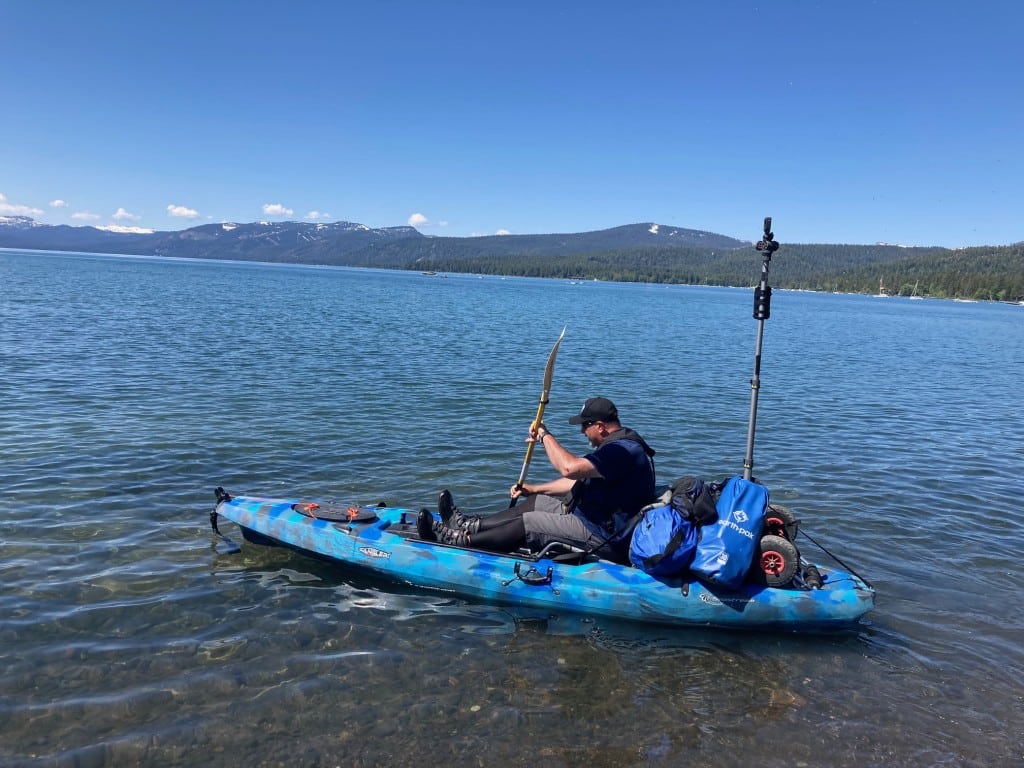
In June of 2022, Brian Footen spent a week paddling a kayak loaded with cameras and monitoring gear along the shoreline of Lake Tahoe. In 2023, he did it again, this time paddling through water that was high and dry the prior year. In addition to a camera sitting on a stand four feet above the boat, there was an underwater camera, and a water quality meter regularly monitoring the health of the lake. It was all part of Earth Views, a nonprofit offering fascinating visual presentation of the entire shore of Lake Tahoe available to scientists and the general public. Those interested in learning more and donating can visit earthviewsociety.org.
Footen is no stranger to monitoring water ecosystems. In recent years he has taken on the Chicago River, Lake Powell and Lake Mead, and has powerful memories of a particularly surreal trip along the shore of the rapidly shrinking Great Salt Lake. Now, his Earth Views Conservation Society has just obtained funding from the State of Washington to provide looks into the 2,500 miles of shoreline that make up the Puget Sound: the second largest estuary in the United States.

Footen came to mapping water bodies after spending twenty years as a fishery scientist for federal, state and tribal agencies. Then he decided he wanted to move in a new direction that would allow him to spend more time in the field instead of staring at a computer. The light bulb for his future came to him in a meeting with his fellow scientists. They were looking at Google Street View to try to locate natural objects, and realized it only catalogs roads and human made features.
Footen realized: “If we did this for rivers and nature, the scientists could use it for their research.”
With the help of friends Scott Gallagher and Rob Crampton, they wired a group of Go Pros together and attached them to a piece of plexiglass to affix to a sailboat and went down the Chicago River. “We thought it would be a cool river to do, since is it quite polluted,” said Footen. The idea was to prove that the contraption could work, so they could get the funding needed to take on more bodies of water to study.
The program was almost a wash out before it began. When getting ready to attach the contraption, Crampton, “dropped it into the Chicago River. It’s a nasty piece of water. Before I know it, he is diving into the river and saved it,” said Footen, who was glad he wasn’t the one to have to dive into that toxic soup.
Soon after, Footen reconnected with an old high school buddy who lived in Reno, and they spent time at Lake Tahoe building an app for the Earth Views concept and trying to sell the idea to investors. Their initial intent was to start their business by doing a full survey of Lake Tahoe, but since they couldn’t find financial backers, Footen returned to his home in Seattle. There he set out to document the impact of the removal of two derelict dams on the Elwha River, in the Olympic National Park west of Seattle.
“It was the largest dam removal at the time in history, and we wanted to see if it would free up the river and all the fish would come back and how the system could recover post dam removal,” said Footen. “Forty-eight hours after they took the dams out, we went 23 miles from where the dam was to the Straight of Juan De Fuca. We were able to show what had changed,” said Footen.
They were able to collect images of Chinook salmon that were the first to make it back to where the dam was, as well as see the stumps from the old growth timber cut down when the dam was created. Following this success, Footen tried to drum up business via presentations to a variety of groups and took on the task of monitoring over a dozen rivers. “Then it got quiet, it was feast or famine. I was wondering if I needed to find a day job,” said Footen.
When Covid hit, things slowed down even more. Footen was staying at home and wondering what he was going to do next when he realized “there had always been an ethos that this was not just about who we contract for to do work, but this has to be public, to be available to inform people about the incredible natural resources we have,” said Footen.
It was then he decided that it was the conservation part of what he was doing, to help people understand how the important bodies of water in the Western United States were threatened, was what he wanted to focus on. So he co-founded the Earth Views Conservation Society as a non-profit organization and started kayaking along the shore of Puget Sound, documenting the heavily impacted area between Seattle and Olympia. They did the first 200 miles, and his report got a lot of attention in the press, shining a light on the environmental issues confronting this vital waterway.
In 2021, Footen set out on a road trip through the drought-stricken West and realized that the Great Salt Lake, the Rio Grande, Lake Powell and Lake Mead were all low and in danger. He mapped short pieces of all of them, and discovered that the greatest public interest in his work seemed to be for Lake Tahoe and the Great Salt Lake.
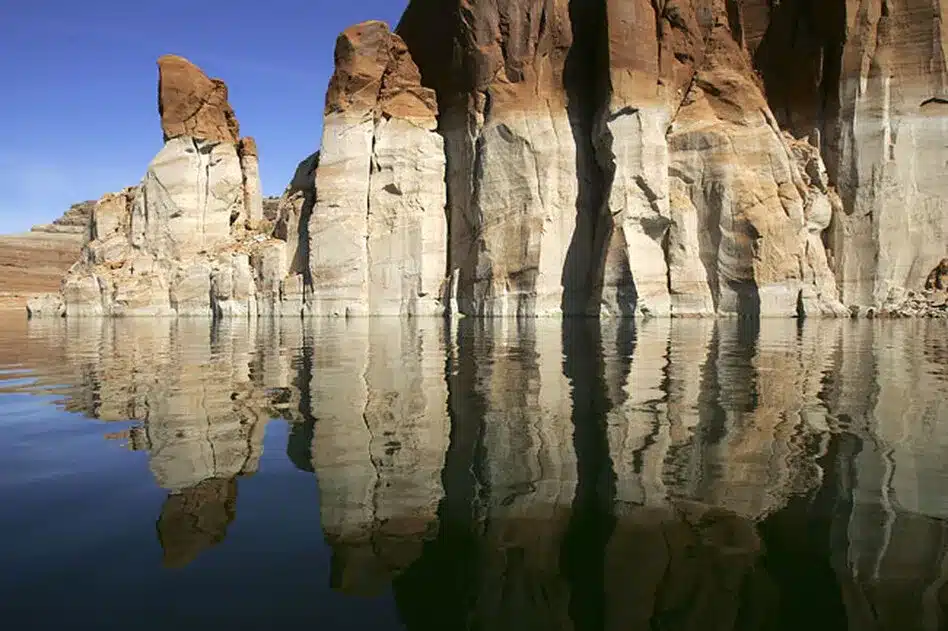
The Great Salt Lake is one of the most isolated, desolate places in the country. Footen packed his kayak with a week of food and water and headed out on two runs in October of 2021. “It was quiet, and really eerily beautiful. Stunningly so. I made it all the way to the north end of the lake. It was the lowest point it has ever been, 23 feet lower than it was in the 1980s,” said Footen.
At one point he had to walk a mile pulling his kayak in three inches of water. “I had to spend my night on my kayak because I couldn’t get to the edge of the water. Things looked closer than it really is. It was a really difficult expedition,” said Footen.
But he also found himself alone at night on this massive and unique lake. The moon was up and he thought this was an experience he would never forget.
The next year, with Tahoe in its third year of drought and the lake near the natural rim, Footen was able to obtain sponsorship from the Tahoe Fund to take on the week long process of slowly circumnavigating the near shore of Lake Tahoe. “I was struck by how beautiful it was and by the contrast between the Nevada and California sides,” Footen said.
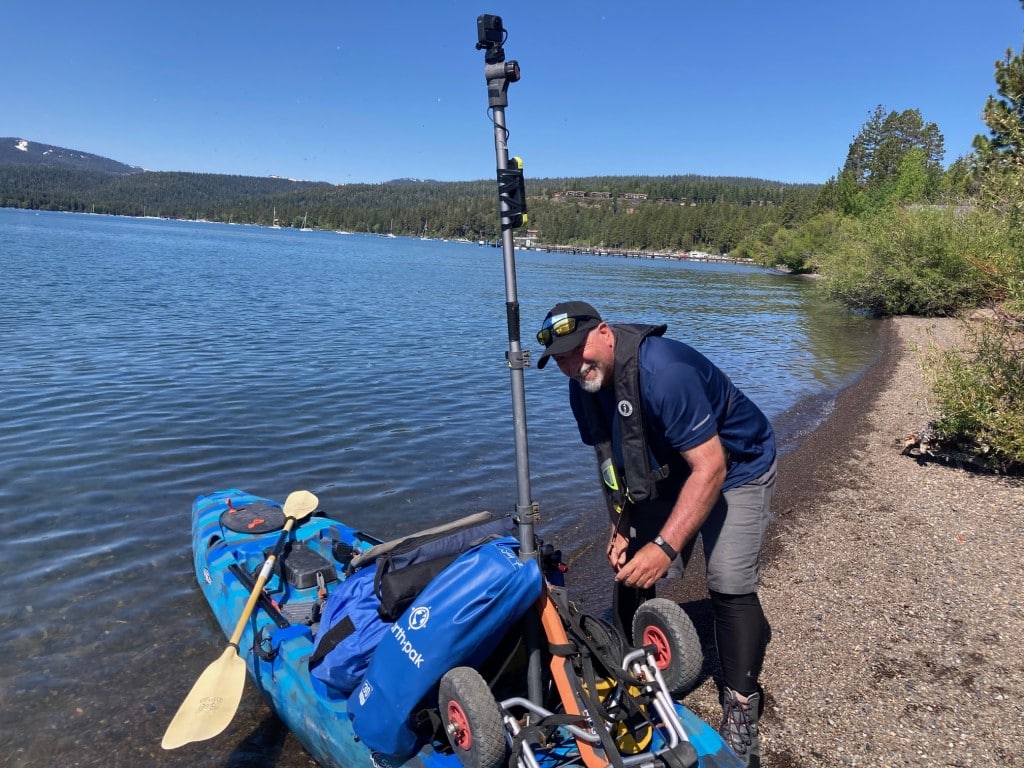
He would camp close to the shore most nights (his heavily laden kayak couldn’t be dragged very far). “Emerald Bay stands out as one of the most beautiful places around the world. To spend the night there under the stars was epic,” said Footen.
When he returned in 2023, Tahoe was a very different lake. “I all of a sudden could paddle into the Upper Truckee River. The tracks of where I went are now pretty separated between 2022 and 2023. The big takeaway from his research was that the lake was a lot more functional at higher water levels. It was overall a healthier ecosystem at 6,228 feet than at 6,224,” said Footen.
While his time in Tahoe was a positive one, he also was concerned about the tremendous impact of the number of people who visit the lake. “I was flabbergasted by Sand Harbor, seven in the morning and the beach is already packed. Wall to wall people at seven a.m.! It was mind blowing!” Footen said.
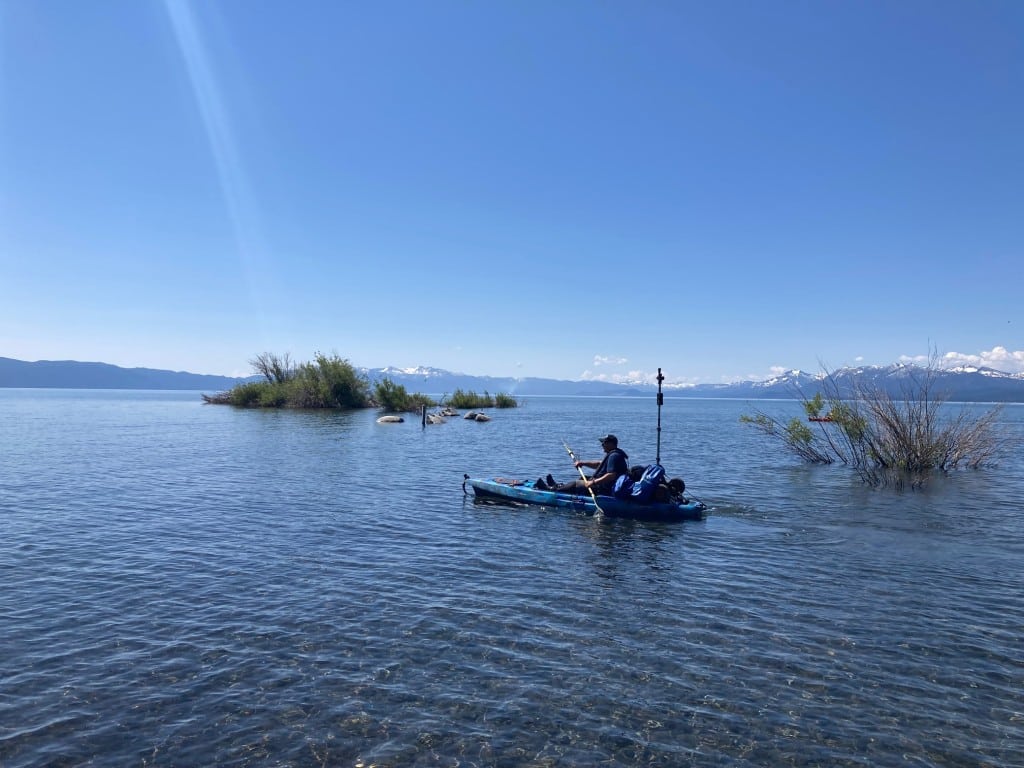
Footen has surely found his purpose in life. Providing the public and scientific communities a close up look at the precious bodies of water we love. His plan is to focus on the Western U.S. and determine the impact of the long term drought on the region. And to answer a question that frequently comes to his mind.
“How do you balance all the different interests with the natural systems? That balance is often far out of whack,” he said.
Republish our stories for free, under a Creative Commons license.
Author

Related Articles
How Are Water Managers Adapting to a Smaller Sierra Snowpack?
Warming winters are reshaping runoff. With less snow to rely on, water managers are navigating a future defined by rain, risk, and uncertainty.
Hard Work, Low Pay, High Risk: Who Wants a Job in Forestry?
How local efforts are helping to better opportunities in forestry for people and the profession.
Ally Audio: Where’s the Mountain Snow We All Love?
Check out the latest edition of Sierra Nevada Ally’s podcast